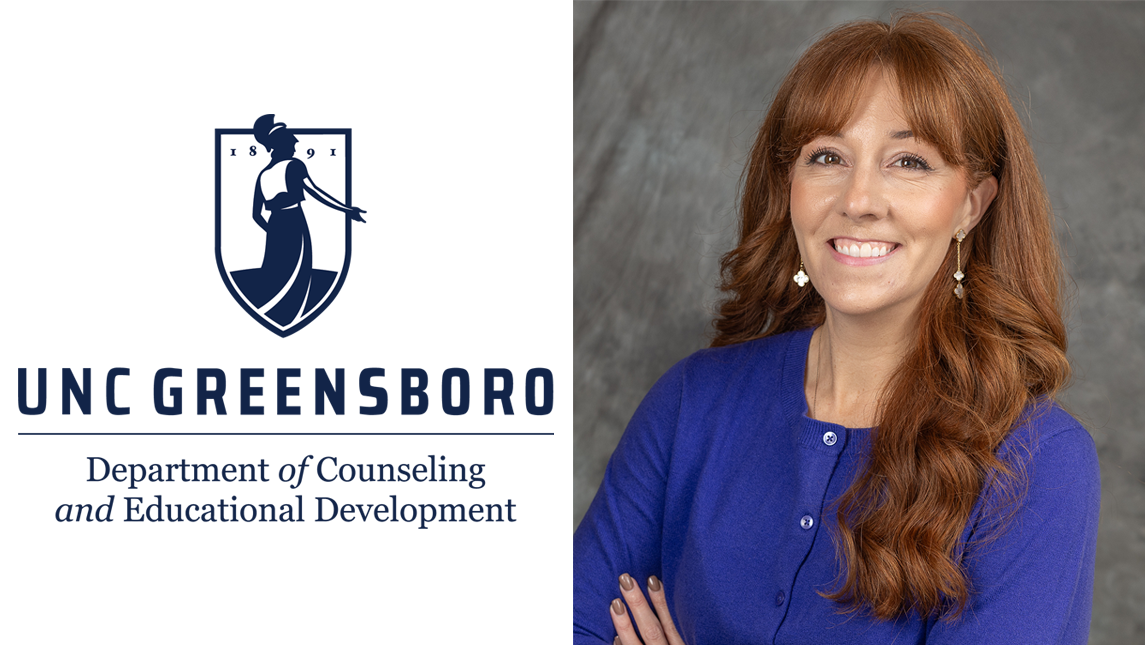
Dr. Jennifer Niles serves as an assistant professor in the Department of Counseling and Educational Development (CED).
What is your educational background?
I earned my bachelor’s degree from Penn State in Human Development and Family Studies. For a while, I was interested in elementary education and working with children. I realized that what I enjoyed about working with kids was the holistic perspective – just understanding kids, not just their academic needs, but also social and emotional needs, and behavioral needs, and even career goals. That led me towards counseling.
After graduating, I did a service year with AmeriCorps at a children’s museum. Then I went to Wake Forest for my master’s degree in school counseling. I graduated in 2012 and then held counseling roles for about eight years. I was a school counselor in Winston-Salem, I had a family clinician position with families and child welfare, and I went back into a school as a social-emotional learning specialist.
Part of the challenge that I was seeing was that there were different opinions about what school counselors were prepared and qualified to do. I noticed that there were inconsistent responses to school counseling and that frustrated me. That is what propelled me towards a doctoral program. So, I went to William & Mary for my doctorate in counselor education and I graduated from there in 2023.
Why did you choose to come to UNCG?
I’ve admired UNCG for a long time because of their legacy in counseling and counselor education. In our profession, the CED program is known as one of the top programs, for being huge contributors to our profession, and huge advocates of our profession.
The faculty here have a legacy, but it is also their humanity. It is a very unique balance that they can strike. They are leaders in research and teaching and supervision in ways that other programs may not be.
There’s an authenticity about the people in our program. We talk about wellness, and I think that’s something that we value as a department, and we’re always reflexively thinking about what our students need.
The more I learned about UNCG as a university, the community engagement element was really appealing to me. The diversity of our students and community was important. There are opportunities to advocate for not only the profession’s needs, but also for what the students need. It feels very meaningful here.
What are your current research interests and what attracted you to those areas?
My background is in school counseling. I look at both what we can do for students and what we can do for school counselors. I had almost a decade of working with people. How can we do what we do effectively for the benefit of our clients and our students. That is very much at the central perspective of my research.
Some of my research is around interventions in schools and that has also included some substance use prevention research in schools and looking at those outcomes of those programs, mostly for middle through high school students.
I’ve also looked at what we can do for school counselors and how we can make sure that school counselors are feeling the self-efficacy that they should feel. What can we do to reduce burnout?
From the school counselor perspective, I’ve been really interested in hope. That’s an area that has not been looked at for school counselors. We see things like self-advocacy, or we see things like altruism being looked at, mindfulness has been looked at, but we hadn’t looked at hope yet.
I began looking at what it means if a school counselor has a certain level of hope. So far, what we’re finding is that it means a lot. If a school counselor has a higher level of hope in general – it doesn’t have to be about school counseling – if they have a goal they think they can achieve and see ways to get to it, if they have that, then they are more likely to do counseling activities. They are more likely to coordinate school-wide programs; they have more multicultural counseling. They have more self-efficacy with navigating ethical and legal issues. They are more satisfied with their jobs.
We’ve built this foundation where hope seems to be really important. So, the next step is if hope is really important, what can we do to strengthen hope, especially with all of the changes that are happening. We are at the initial IRB stages of what predicts hope. What are the things that make someone have more hope? Is it more resources? Is it the setting? Is it just a person’s self? Once we identify some of those elements, then we would build some type of intervention for practicing school counselors that targets those specific areas. Hopefully, that would allow us to measure outcomes based on that design.
What are you hoping to accomplish with Your Research?
I want school counselors to feel good about the work that they are doing. I want them to feel advocated for.
It does come down to some professional advocacy. I believe in school counseling and I believe in what it does for students and the impacts of that well into the future for individuals and for society.
The resource of school counseling is important for the benefit of students and families in schools. I would want my research to have an impact on outcomes that we can see in schools. I see that becoming intervention and school-based programming that can be measured and explored.
How do students assist with your research?
I’ve had doctoral students work with me on projects that we’ve gotten to publication finish lines, which is exciting. They’ve had the role of idea conceptualization. We work together on thinking it through and maybe practicing some methodology. Students have co-authored things and written parts of articles.
I try to do things in a collaborative way where they’re learning and I’m also learning. Students are really involved in all elements of the process.
Some former master’s students, who are now alums, still work with me on projects. They’ve been part of the development of the idea, writing up the results, and the implications for practitioners. Especially because our master’s students are in their practicum or internship placements, or if they’re a recent alum, they are in practice, so having that voice of a practitioner is really beneficial in a manuscript. I think it makes it more accessible for readers.
I love the mentoring process through research. I did not feel much self-efficacy as a researcher to begin with. I doubted my ability to do research as I entered the doctoral program at William & Mary. I was lucky to have a mentor who saw something in me and was able to push me towards taking risks with research in ways that helped me learn – whether it was writing, or trying out different analysis, or recruiting styles. From that, I was able to grow as a researcher. It feels important for me to pay that forward with our doctoral students, especially because many do come in with a doubt about their abilities to do research.
What advice would you give people who are Considering GOING into THIS FIELD OF Work?
For people considering school counseling, I would say adaptability and flexibility are really important. There are a lot of day-to-day changes to the schedule. The more that you can adapt and work with those changes, the better you can be for yourself and for your students.
I’d also say to find the thing that is the purpose or meaning behind why you’re doing this. That’s an exciting thing. When our school counseling cohorts enter the program and talk about their reasons for being her, it’s really exciting to hear. The more we can come back to that and anchor ourselves back in with a sense of purpose, the more we can adapt and shift with the changes and find success.
For those looking at counselor education, I think it’s important to be open to taking risks. Healthy risks are a big part of learning. Be OK with making mistakes in writing or making mistakes with analysis. Learn through that. Have a willingness to try. It can feel intimidating, but that’s where the win comes from. There are opportunities to grow if you’re willing to take the risks.
What do you enjoy outside of work?
I have two children, a 10-year-old and an eight-year-old. My life outside of work revolves around them. I have been really loving this age that they’re at and getting into what they are into. I grew up playing tennis, but haven’t played for a long time. Now, my kids are getting into tennis so doing that together is fun. I also enjoy playing guitar.
If you were given $1 million to use on your research, what impact would that make?
It would help with connecting with school counselors. It would be an opportunity to have research assistants or a lab of students that could help do community-engaged work and learn about the process.
I’ve also been interested in a youth participatory action research model or a community-based participatory action research project. That type of funding would allow me to create programming.