Dr. Faith Rice serves as an assistant professor in the Department of Information, Library, and Research Sciences.
What is your educational background?
I have a bachelor’s in poetry from Columbia College Chicago. I’ve been a spoken word poet since I was eight years old. I then got a master’s in early childhood education and was a teacher for three years. Then I went back and got a dual degree in library science and business. My master’s degrees are from Dominican University. Then I got my Ph.D. in information and library science at Dominican.
Why did you choose to come to UNCG?
I have wanted to move to North Carolina since I was 16 years old because I watched a romance movie and thought it looked beautiful. Then I met a colleague when I was in grad school who was from North Carolina. She kept talking about how much she loved it here and couldn’t wait to come back. It kind of cemented my desire to be here.
I was at an ALISE conference a few years ago presenting on my dissertation on youth information behavior and I met a couple of people from the University of North Carolina, Chapel Hill. I applied for a job at Chapel Hill, but by the time I had applied, they had already picked their candidates. So it was too late for me. Then I got and email from Noah (Lenstra) and applied for the position here.
I met the staff and understood that there was a connection between the School of Education and the library science program. I knew that I was coming to the right place because my background is in education. I’ve been passionate about youth and education my entire life. I’m just grateful that it was in the place that I always wanted to be and grateful that it was within the field that I was interested in.
What are your current research interests and what attracted you to those areas?
I come from extreme poverty, and I grew up in some of the most impoverished, dangerous neighborhoods in Chicago. Even though I grew up in those neighborhoods, my mom was a teacher and wouldn’t let me off the hook educationally. I had to go to school, and she got me into a select enrollment school – Gwendolyn Brooks College Prep.
Even though I was getting straight A’s, I was a little bit of a troubled student. I got suspended for a month and put into a second-chance program. What I noticed was that I was the only one that was like me in the program, a straight A student with a good education, but also from a very troubled background. Everybody else was from schools that didn’t meet the standard criteria for basic education and had troubled backgrounds. We shared stories about what we were learning in school. I was like, it’s not fair that I’m learning above high school grade level and you guys are still learning sixth-grade level concepts. That’s when I started to notice the disparity in the educational system.
At that moment I decided I was going to be a teacher. Then I got into college and ended up in Teach for America after I graduated. They were talking to us about the school-to-prison pipeline and the academic achievement gap. I was going to conferences and trainings about these topics. After being a teacher for three years, I really didn’t think that as a teacher I could make the difference that I wanted to make.
I was already working at the library, and I noticed the children’s librarian and the work she was doing. I thought, ‘What if we were able to help close the academic achievement gap in non-traditional educational spaces like libraries?’
I got my library science degree and then spent a year trying to think about it and piece it together after becoming a librarian.
My specialty is youth information and behavior, specifically cultural – focusing on cultural literacy and epistemic injustice. I discovered so much in my Ph.D. program about intercultural information ethics, social and cultural differences, and information behavior in general.
I’ve got all of that mixed together with the idea of knowledge acquisition and development and how that leads to academic achievement.
I decided to study the youth who were on the lower end of that gap to see how they processed information versus the youth that were on the higher end of the gap. I’ve found that there’s an embedded distrust, culturally, of information institutions and information sources.
We have to change what we see as valid information. I know that’s a deep change that has to be made, but we have to validate other cultures. We have to be able to say, ‘OK, this did not come from a peer-reviewed article. This came from a first-person perspective of a Black person, or a Native American, or a Hispanic person.’ That is still a valid source of information.
What are you hoping to accomplish with Your Research?
My hope is that public libraries start to reimagine traditional narratives in their collections and start to think about ways to fulfill their mission. Provide access to multiple voices. I would like to see the collections match the community. If your community is predominantly Black, then you need to have books by Black authors, or about Black kids, or about Black people.
I would like to see schools be more intentional about their relationships with public libraries. In the early 1990s, when that relationship was more solid, the literacy rate was the highest it has ever been in the United States. But eventually they separated them out and the literacy rate has been on a steady decline.
How do students assist with your research?
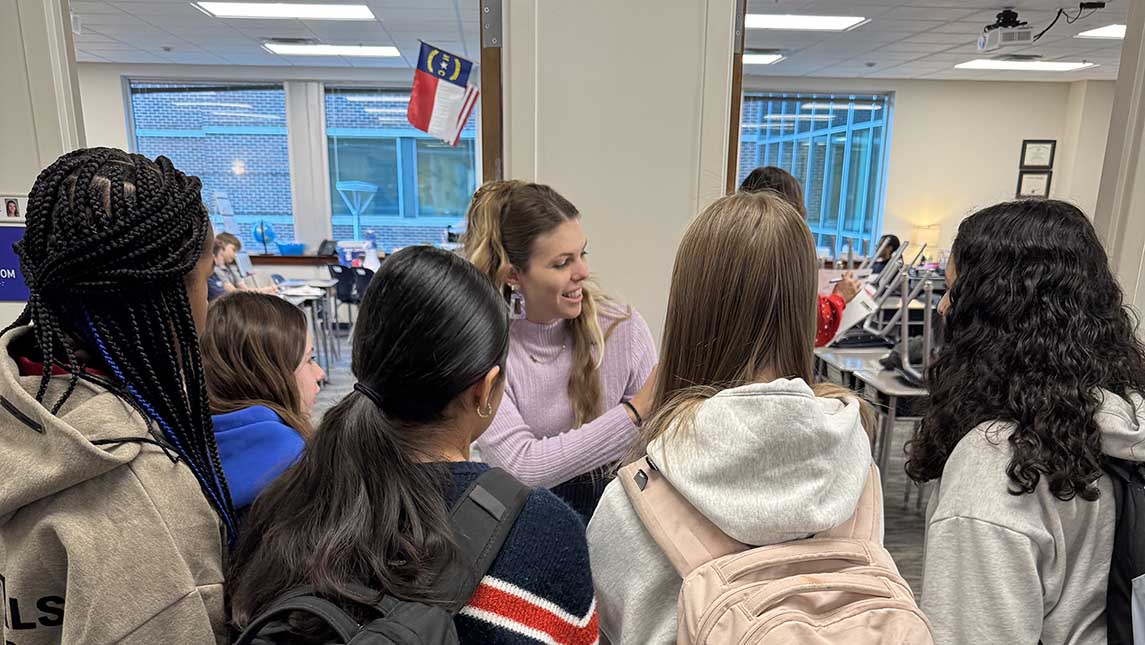
For me, students are at the heart of my research. I came here for the research, but what really drives me is impact – especially the kind that happens through teaching and mentorship. My goal is to help students think about the challenges in public librarianship and how to address them without losing themselves in the process.
Having open conversations with my graduate students about their experiences helps me process my own research and often sparks new ideas. Those discussions ground my work in the realities of the field and remind me why this research matters. I also have a graduate assistant who helps me pull articles, organize materials, and gather information for my classes and future projects, which keeps my research connected to current trends and practical applications.
What advice would you give people who are Considering GOING into THIS FIELD OF Work?
Learn how to listen without judgement. I think that listening is one of the most important skills as a librarian because your job, first and foremost, is to meet people where they are and assist them with what they need. The best way to do that is to learn how to listen effectively.
Learn how to listen intentionally by asking follow up questions, validating what the person is saying, and making sure that you both are on the same page regardless of whatever barriers are present at the moment. It will make a huge difference in the work that you do, both professionally and personally.
The other part of my advice would be to know that we’re not here to fix it. We’re here to give them resources so they can fix it on their own. We’re not here to solve problems. We’re here to help them solve their own problems, and we need to trust people to do that. Our job is to give them the tools to do so. We’re not here to judge. We’re not here to tell them what to do or how to do it. We’re literally here just to give them the resources so they can get from point A to point B.
What do you enjoy outside of work?
The first thing is that I’m a mom. My two boys motivate me very much. I want to be the type of parent that raises two boys with a lot of integrity.
I’m also an artist. I’m a poet. I’ve been writing poetry since I was eight years old. Making space for my creative side is important to me. I try to reserve 30 minutes a day to just write poetry or do some journaling.
If you were given $1 million to use on your research, what impact would that make?
First, I would finish my research. I would use that money to visit places like South Korea because of their high educational attainment. I want to know what they’re doing differently with their youth. I would maybe visit Australia because their library system is so deeply embedded into their educational system. I would want to know how they build that into their culture. My goal would be to bring those insights back – to reimagine how public libraries in the U.S. can better support youth development and their academic achievement. I’d probably start an educational campaign around it.