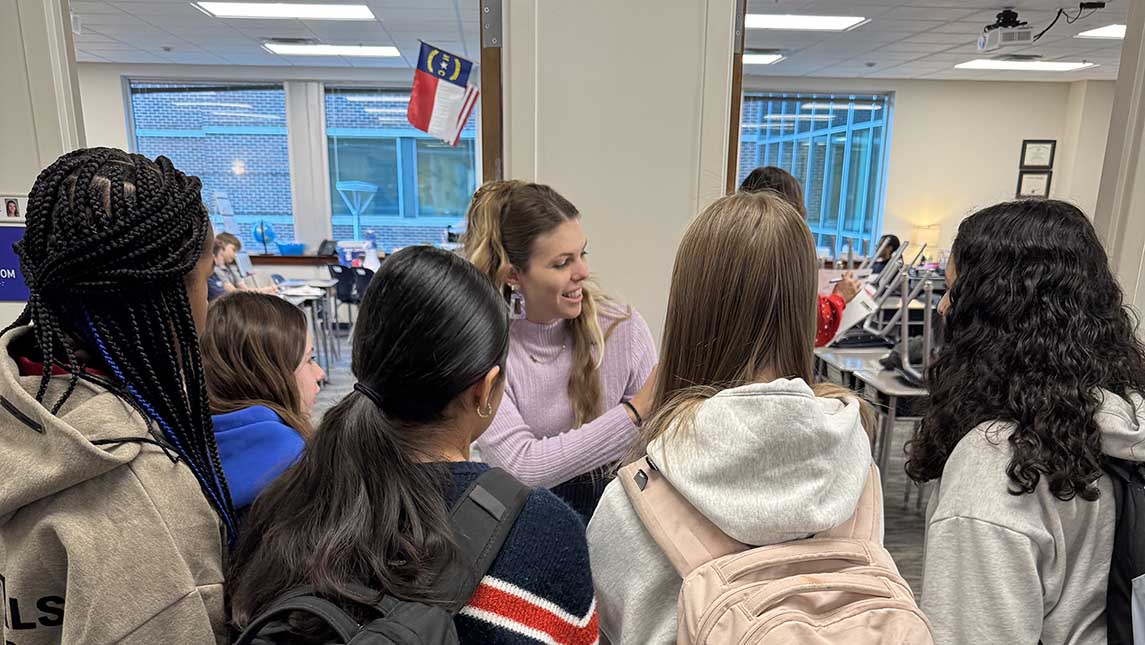
With nearly 300 dual language immersion programs across the state of North Carolina, the state is among the national leaders in such offerings for its students. These programs allow students to learn in a multitude of languages, preparing them for life in a global society.
In North Carolina, you will find K-12 programs in eight different languages – Cherokee, Chinese, French, German, Greek, Japanese, Spanish, and Urdu. The state has offered language immersion programs since the fall of 1990.
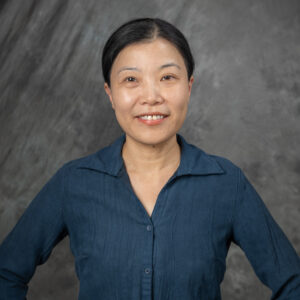
Dr. Ye “Jane” He, the Helena Gabriel Houston Distinguished Professor for Elementary Education in the UNC Greensboro School of Education, has been working closely with individual schools, local districts, and teachers for years to provide professional development and assistance with their programs.
Her work began with partner schools upon her arrival at UNCG. One of her earliest projects involved working with Chatham County Schools through a grant as the county was developing its dual language program.
Dr. He said, “Dual language immersion is one way to be a part of the multicultural education effort. The Department of Public Instruction has supported the growth of dual language immersion programs to encourage both one-way and two-way programs.”
What Dual Language Immersion Is – And Is Not
One-way programs typically engage native English speakers to learn an additional language through immersion. Two-way programs allow students who come from a multilingual background to learn in both English and what may be a language traditionally spoken in their homes (learn more about the Dual Language Immersion, or DL/I, program from the North Carolina Department of Public Instruction).
When students participate in an immersion program, content areas are actually taught in partner languages. So, students in a Spanish immersion program can also learn math, science, and social studies in that language.
Dr. He said, “In multilingual education, the dual language immersion program is ideal to support learners’ development, not only in language, but in their development of world knowledge through language development.”
The majority of these programs are found at the elementary level; however, many districts have developed programs that feed into both middle and high school.
Studies have shown that students who are part of a language immersion program perform better on standardized tests in reading, math, and science.
Said Dubraska Stines, the multilingual learner program coordinator for Asheboro City Schools, “Research shows that the bilingual brain develops different areas. There is more plasticity in the brain. Students tend to be better problem solvers. Students are learning the language of the culture that they are learning. We see students come together and learn from one another.”
Supporting Educators Statewide
With a background focused on educator preparation, Dr. He views her role as one of support for teachers across North Carolina. That has manifested in courses offered at UNCG and in professional development opportunities for those currently in classrooms.
Dr. He said, “It’s always been my desire to offer support through different ways. Over time, that has evolved and many of these professional learning efforts are driven by the districts and by educators.”
That has led to the development of a statewide professional learning communities (PLCs) where educators are able to propose a topic of interest and decide what topic they would like to engage in to develop their knowledge and skills. In this setup, the university assists with providing resources to assist educators in these discussions.
Dr. Kimberly Pilling, the world language director for Guilford County Schools, said, “What we found is that there’s not a lot of professional development or teacher training specifically for dual language or immersion teachers. Jane has always been great to offer support for professional development for our English as a second language teachers.”
Many of the educators who participate in these PLCs already have years of experience in the field of language education. They join this network in order to find new ideas and exchange concepts with fellow teachers.
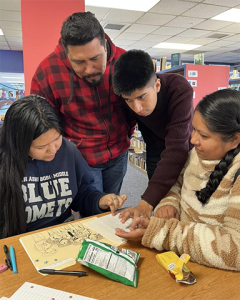
Through the work of Dr. He and her colleagues, multilingual educators are able to participate in state and regional conferences, share ideas, and contribute to service-learning projects.
Dr. He said, “From the university, I think all of us buy into this concept of communities of practice. We’re learning from one another and the faculty at the university just serves as the facilitator to cultivate the learning space where we encourage those types of learning exchanges.”
These experiences have developed programs such as the Heritage Language Academy in Asheboro City Schools. It began with a teacher who identified a need in and has grown and been impactful within the community. This program began in 2008, prior to the district implementing a dual language program.
The Heritage Language Academy supports students and families that speak primarily Spanish by helping the participants develop English literacy, math skills, and build cultural connections.
Said Stines, the multilingual learner program coordinator for Asheboro City Schools, “The Heritage Language Academy was started because we recognized the need to support the bilingualism in students and their families. Through grants that have been sponsored by UNCG, we have been able to implement this program. We would have never imagined that that would have culminated in us starting a dual program.”
Research opportunities have also grown from these conversations. Among them was the Multilingual Learner Success Project, a project that allowed educators from across the state to engage in research efforts. Participants were able to look at data from multilingual learners in various kinds of programs to analyze the impact on student growth for students in those programs.
Administrators are also supported through this work. Recently, Dr. He worked with the leadership of Guilford County Schools, Iredell-Statesville Schools, and Winston-Salem/Forsyth County Schools to support DL/I professional learning exchanges in the state. This group has identified areas of need for professional development and created a series of webinars and sessions created by teachers and educators. It has also provided administrative training for principals and assistant principals.
Growth of Programs in North Carolina
Since these language immersion programs began in North Carolina over 30 years ago, they have evolved and grown. That growth is driven by demographics and demand from families, both native English-speaking families and multilingual families.
Dr. He said, “Our students are coming in with a multilingual background. Families have a desire for their children to be multilingual as they grow up. In North Carolina, roughly 20% of students come from a background where they experience multilingualism. More students are learning an additional language – whether they are in class learning it, or beyond the class learning it, or they have an interest in learning it.”
According to Pilling, partnerships with universities like UNCG have helped to fuel the growth of programs. She said, “There are so many great schools and universities who are committed to eduction.”
Preparing Teachers for Multilingual Classrooms
It takes a specific type of teacher to lead a language immersion or multilingual classroom. Not only do they have to understand the concepts for math or science, but they also need to use the partner language in instruction.
Dr. He said, “Educators need to have some knowledge of the language itself. If you are teaching English to someone whose first language is not English, or who is still developing their English language proficiency, just speaking English is not enough. You need to be able to recognize the patterns of development of the children and the nuance of the language that you need to teach.”
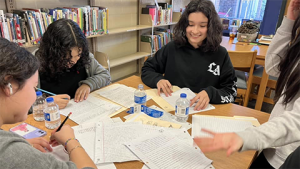
That begins with teacher preparation. Teachers must be prepared to be flexible and willing to work with their students.
Dr. He said, “There’s no one-size-fits-all model. In our program, we do not say, ‘Here is a list of 10 best practices.’ It does not work like that. A great teacher is a thoughtful teacher. You may have had the best lesson plan, but you go into the classroom, and you notice something is going on in the classroom. You need to be ready to adapt and change to meet the needs of students and guide them.”
The collaborations with districts and the Department of Public Instruction allow for better preparation of future teachers because the faculty members understand what is happening in districts.
Said Dr. Leslie Baldwin, the world languages and dual language immersion program manager for Winston-Salem/Forsyth County Schools, “UNCG allows students to have opportunities to have classroom experiences in a variety of schools and settings through different courses. That is huge for any pre-service teacher to get experience in schools, in classrooms, so that it is not all theoretical. UNCG also does a good job partnering with local districts and schools. There are courses specifically for pre-service teachers that want to go into a multilingual setting. That is a unique thing.”
Moving Forward
Continuing to build partnerships and provide all parties – districts, classroom teachers, and future teachers – with opportunities to network and collaborate is imperative to the continued success of these multilingual programs. Expanding community engagement can also help make these programs flourish. Developing pathways for teachers to grow and become school and district leaders is also key.
For Dr. He, seeing the impact that this network has had on educators has been special. She said, “My reach is limited. Any individual’s reach is limited. We can only engage with so many stakeholders in our lifetime, but knowing the stories that educators bring back and share, it is the generative impact for the well-being of the community. It is about the community thriving.”
That generative impact and collective growth will continue to push Dr. He to continue this work.