

The School of Education at UNC Greensboro is proud to hold accreditation from multiple respected organizations, affirming our commitment to academic excellence, professional standards, and continuous improvement across our programs.

Accreditation Bodies

ALA

The Master of Library and Information Studies (MLIS) program at UNC Greensboro is fully accredited by the American Library Association (ALA). Accreditation was granted on June 25, 2018, affirming the program’s commitment to excellence in library and information science education. The next comprehensive review is scheduled for 2026.

Review our assessment information to learn more about our student achievement data.

CACREP

The counselor preparation programs within the Department of Counseling and Educational Development are CACREP (Council for Accreditation of Counseling and Related Educational Programs) accredited and offer excellent training through the Master’s and Doctoral Degrees.

Review our CACREP Annual Program Evaluation to learn about timely completion rates, licensure/certification exam pass rates, and job placement rates.

CAEP

UNC Greensboro is accredited under the Council for the Accreditation of Educator Preparation (CAEP) Standards at the Initial and Advanced levels through Spring 2029. The next site review will take place in Fall 2028.


CAEP

Initial Preparation Programs

  • Birth-Kindergarten (UG, PBIL)
  • Deaf and Hard of Hearing (UG)
  • Elementary (UG, MAT, NCT)
  • Elementary & SpEd (UG)
  • English (UG, MAT, NCT)
  • English for Speakers of Other Languages (MAT, NCT)
  • French (UG, MAT, NCT)
  • Health and PE (UG, LO)
  • Latin (NCT)
  • Mathematics (UG, MAT, NCT)
  • Middle Grades (UG, MAT, NCT)
  • Science (UG, MAT, NCT)
  • Social Studies (UG, MAT, NCT)
  • Spanish (UG, MAT, NCT)
  • Special Education General Curriculum (UG, MAT, PAIL)

Advanced Preparation Programs

  • *Elementary Math (MEd, AO)
  • *Elementary Science (MEd, AO)
  • *English for Speakers of Other Languages (MEd, AO)
  • *French (MEd)
  • *Mathematics (MEd)
  • *Reading/Literacy (MEd, AO)
  • School Administration (MSA, PMC)
  • *Science (MEd)
  • *Social Studies (MEd)
  • *Spanish (MEd)
  • Special Education General Curriculum (MEd)
  • *Concentration within the MEd in Teacher Education

Key

  • UG- Undergraduate
  • MAT- Master in the Art of Teaching
  • NCT- NCTeach non degree licensure only
  • LO- Licensure only
  • PBIL- Post Baccalaureate Initial Licensure
  • PAIL- Postbaccalaureate Alternative Initial Licensure
  • MEd- Master of Education
  • MSA- Masters in School Administration
  • PMC- Post Masters Certificate
  • AO- Add on

Professional Education Data

This set of assessments aligns to CAEP Annual Report Measure 1: Completer Effectiveness (Component R4.1).

The graph below shows data collected on beginning teachers (3 years of service or less) in public schools in North Carolina. The bars show the percentages of P-12 students taught by beginning teachers who do not meet, meet, or exceed their expected growth in learning for that year. The graph below shows the most recent data available to us as of April 2025.
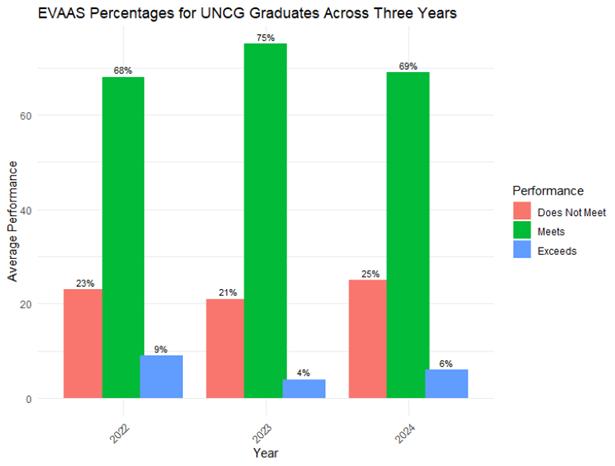
Bar chart displaying EVAAS performance percentages for UNCG graduates across three years (2022, 2023, and 2024). The performance is categorized into three levels: 'Does Not Meet' (red), 'Meets' (green), and 'Exceeds' (blue). Each year has three corresponding bars showing the percentage of graduates in each category. In 2022, 23% did not meet, 68% met, and 9% exceeded expectations. In 2023, 21% did not meet, 75% met, and 4% exceeded expectations. In 2024, 25% did not meet, 69% met, and 6% exceeded expectations. A legend on the right clarifies the color coding."

The graph below compares the data for UNCG graduates to the state data. In the most recent year (2024), UNCG had a lower percentage of completers who met and exceeded expected growth than the state.  Overall, UNCG’s percentage of completers who met or exceeded expected growth was 75%. Year after year, the impact of UNCG graduates remains relatively consistent, although there has been a slight drop in the percentage of graduates meeting and exceeding expectations in the most recent year.

A horizontal bar chart titled "EVAAS Performance Comparison between UNCG and the State of NC" compares student performance levels across three years (2022, 2023, and 2024) for both the State of NC and UNCG. The three performance levels are color-coded: "Does Not Meet" (green), "Meets" (orange), and "Exceeds" (blue). For the State of NC, the percentage of students who did not meet expectations was 19% in 2022, 21% in 2023, and 18% in 2024. The percentage who met expectations was 70%, 69%, and 73%, respectively, while those who exceeded expectations were 11%, 10%, and 9%. For UNCG, the percentage of students who did not meet expectations was 23% in 2022, 21% in 2023, and 25% in 2024. The percentage who met expectations was 68%, 75%, and 69%, while those who exceeded expectations were 9%, 4%, and 6%, respectively.

This set of assessments aligns to CAEP Annual Report Measure 1: Completer Effectiveness (Component R4.1).

The graphs show data collected on beginning teachers (3 years of service or less) in public schools in North Carolina. The bars show the percentage of UNCG alumni that are rated at each level on key performance areas compared to all beginning teachers in the state. The performance ratings are made by the principal. The key performance areas are aligned to state teaching standards:

  • Standard 1: Teachers Demonstrate Leadership
  • Standard 2: Teachers Establish a Respectful Environment for a Diverse Population of Students
  • Standard 3: Teachers Know the Content They Teach
  • Standard 4: Teachers Facilitate Learning for Their Students
  • Standard 5: Teachers Reflect on Their Practice

The graphs below show the most recent three years of data available to us as of April 2025 (from AY 2021-22, 2022-23, and 2023-24).
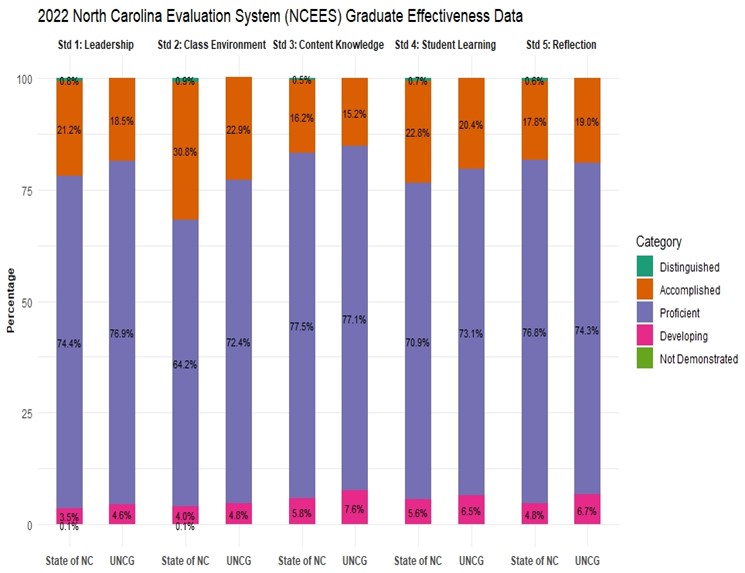
The image is a stacked bar chart titled "2022 North Carolina Evaluation System (NCEES) Graduate Effectiveness Data." It presents the percentage distribution of evaluation results across five standards: Leadership, Class Environment, Content Knowledge, Student Learning, and Reflection. The data is shown separately for the State of North Carolina (State of NC) and the University of North Carolina at Greensboro (UNCG). Each standard is represented by a pair of bars, one for the State of NC and one for UNCG. The bars are divided into five categories: Distinguished (teal green), Accomplished (orange), Proficient (purple), Developing (pink), and Not Demonstrated (olive green). A color-coded legend on the right side of the chart defines each category. The y-axis represents percentages from 0% to 100%, and the x-axis represents the different evaluation standards for the two groups.  

For Standard 1: Leadership, the State of NC has 0.1% Distinguished, 21.2% Accomplished, 74.4% Proficient, 3.5% Developing, and 0.8% Not Demonstrated. UNCG has 0.1% Distinguished, 18.5% Accomplished, 76.9% Proficient, 4.6% Developing, and 0.0% Not Demonstrated. 

For Standard 2: Class Environment, the State of NC has 0.1% Distinguished, 30.8% Accomplished, 64.2% Proficient, 4.0% Developing, and 0.9% Not Demonstrated. UNCG has 0.1% Distinguished, 22.2% Accomplished, 72.4% Proficient, 4.8% Developing, and 0.5% Not Demonstrated. 

For Standard 3: Content Knowledge, the State of NC has 0.1% Distinguished, 16.2% Accomplished, 77.5% Proficient, 5.8% Developing, and 0.5% Not Demonstrated. UNCG has 0.1% Distinguished, 15.2% Accomplished, 77.1% Proficient, 7.6% Developing, and 0.0% Not Demonstrated. 

For Standard 4: Student Learning, the State of NC has 0.1% Distinguished, 22.8% Accomplished, 70.9% Proficient, 5.6% Developing, and 0.7% Not Demonstrated. UNCG has 0.1% Distinguished, 20.4% Accomplished, 73.1% Proficient, 6.5% Developing, and 0.0% Not Demonstrated. 

For Standard 5: Reflection, the State of NC has 0.1% Distinguished, 17.8% Accomplished, 76.8% Proficient, 4.8% Developing, and 0.6% Not Demonstrated. UNCG has 0.1% Distinguished, 19.0% Accomplished, 74.3% Proficient, 6.7% Developing, and 0.0% Not Demonstrated.
The image is a stacked bar chart titled "2023 North Carolina Evaluation System (NCEES) Graduate Effectiveness Data." It presents the percentage distribution of evaluation results across five standards: Leadership, Class Environment, Content Knowledge, Student Learning, and Reflection. The data is shown separately for the State of North Carolina (State of NC) and the University of North Carolina at Greensboro (UNCG). Each standard is represented by a pair of bars, one for the State of NC and one for UNCG. The bars are divided into five categories: Distinguished (teal green), Accomplished (orange), Proficient (purple), Developing (pink), and Not Demonstrated (olive Green). A color-coded legend on the right side of the chart defines each category. The y-axis represents percentages from 0% to 100%, and the x-axis represents the different evaluation standards for the two groups. For Standard 1: Leadership, the State of NC has 0.1% Distinguished, 23.9% Accomplished, 71.9% Proficient, 3.1% Developing, and 0.1% Not Demonstrated. UNCG has 0.1% Distinguished, 23.9% Accomplished, 73.6% Proficient, 2.5% Developing, and 0.0% Not Demonstrated. For Standard 2: Class Environment, the State of NC has 0.1% Distinguished, 32.3% Accomplished, 63.5% Proficient, 3.0% Developing, and 1.2% Not Demonstrated. UNCG has 0.1% Distinguished, 29.8% Accomplished, 66.7% Proficient, 2.6% Developing, and 1.2% Not Demonstrated. For Standard 3: Content Knowledge, the State of NC has 0.5% Distinguished, 18.6% Accomplished, 76.6% Proficient, 4.3% Developing, and 0.0% Not Demonstrated. UNCG has 0.5% Distinguished, 16.7% Accomplished, 81.6% Proficient, 0.9% Developing, and 0.3% Not Demonstrated. For Standard 4: Student Learning, the State of NC has 0.7% Distinguished, 25.4% Accomplished, 69.5% Proficient, 4.2% Developing, and 0.1% Not Demonstrated. UNCG has 0.7% Distinguished, 24.9% Accomplished, 69.4% Proficient, 5.8% Developing, and 0.0% Not Demonstrated. For Standard 5: Reflection, the State of NC has 0.7% Distinguished, 21.7% Accomplished, 73.5% Proficient, 4.1% Developing, and 0.0% Not Demonstrated. UNCG has 0.9% Distinguished, 16.7% Accomplished, 79.8% Proficient, 2.6% Developing, and 0.0% Not Demonstrated.
The image is a stacked bar chart titled "2024 North Carolina Evaluation System (NCEES) Graduate Effectiveness Data." It presents the percentage distribution of evaluation results across five standards: Leadership, Class Environment, Content Knowledge, Student Learning, and Reflection. The data is shown separately for the State of North Carolina (State of NC) and the University of North Carolina at Greensboro (UNCG). A color-coded legend on the right side of the chart defines each category. The y-axis represents percentages from 0% to 100%, and the x-axis represents the different evaluation standards for the two groups. Each standard is represented by a pair of bars, one for the State of NC and one for UNCG. The bars are divided into five categories: Distinguished (teal green), Accomplished (orange), Proficient (purple), Developing (pink), and Not Demonstrated (olive red). For Standard 1: Leadership, the State of NC has 2.0% Distinguished, 28.8% Accomplished, 66.2% Proficient, 3.0% Developing, and 0.0% Not Demonstrated. UNCG has 0.8% Distinguished, 17.1% Accomplished, 79.8% Proficient, 2.6% Developing, and 0.0% Not Demonstrated. For Standard 2: Class Environment, the State of NC has 1.6% Distinguished, 34.1% Accomplished, 60.5% Proficient, 3.8% Developing, and 0.0% Not Demonstrated. UNCG has 0.5% Distinguished, 21.6% Accomplished, 73.2% Proficient, 4.7% Developing, and 0.0% Not Demonstrated. For Standard 3: Content Knowledge, the State of NC has 0.8% Distinguished, 20.6% Accomplished, 73.4% Proficient, 5.3% Developing, and 0.0% Not Demonstrated. UNCG has 0.5% Distinguished, 10.5% Accomplished, 83.7% Proficient, 5.3% Developing, and 0.0% Not Demonstrated. For Standard 4: Student Learning, the State of NC has 0.7% Distinguished, 29.2% Accomplished, 64.5% Proficient, 5.6% Developing, and 0.0% Not Demonstrated. UNCG has 0.7% Distinguished, 15.0% Accomplished, 76.2% Proficient, 8.3% Developing, and 0.0% Not Demonstrated. For Standard 5: Reflection, the State of NC has 1.0% Distinguished, 23.1% Accomplished, 71.4% Proficient, 4.5% Developing, and 0.0% Not Demonstrated. UNCG has 0.5% Distinguished, 13.1% Accomplished, 83.2% Proficient, 3.2% Developing, and 0.0% Not Demonstrated.

This set of assessments aligns to CAEP Annual Report Measure 2: Satisfaction of employers and stakeholder involvement (Components R4.2, R5.3, RA 4.1). 

Representatives from NCDPI, the Education Policy Initiative at Carolina (EPIC), and EPP faculty from both public and private institutions worked collaboratively to create The NC Employer Survey (NCES). First administered in 2017 and then annually, the NCES includes items that are aligned with the state’s professional teaching standards. The survey is completed by school principals (or assistant principals) for each of the first-year teachers employed at their school. The 2025 NC Employer survey contained 29 items concerning the effectiveness of UNCG graduate employees. Each item represents a different “teaching task.” Principals responded to the following question stem: “Relative to other first-year teachers, how effective was INSERT TEACHER NAME at the following teaching tasks” using the following response scale: Much less effective (1), Less effective (2), Comparable (3), More effective (4), Much more effective (5). 

The results of the NC Employer Survey over three years indicate that 88% of employers consider UNCG initial licensure completers to be at least as effective as other beginning teachers prepared in NC on all standards. Across three years of data, Standard 1 is the weakest standard, with the largest numbers of completers rated in the lowest categories. Notably, in the most recent year, 100% of UNCG completers were rated as “comparable” to other first year teachers or better. 

NC EMPLOYER SURVEY AVERAGE PERCENTAGES ACROSS NC PROFESSIONAL TEACHING STANDARDS 2022

The table below denotes an employer response rate of 47% for UNCG and 63% for All NC EPPs. 

NMuch lessLessComparableMoreMuch more
2022 (UNCG) Std I: Leadership 81 3% 9% 52% 25% 11% 
Std II: Classroom Environment 4% 7% 49% 25% 14% 
Std III: Content Knowledge 3% 6% 56% 25% 10% 
Std IV: Facilitating Student Learning 3% 7% 55% 24% 10% 
Std V: Reflecting on Practice 3% 8% 55% 26% 9% 
 
2022 (All NC EPPs) Std I: Leadership 1609 1% 7% 50% 30% 12% 
Std II: Classroom Environment 1% 6% 49% 29% 15% 
Std III: Content Knowledge 1% 4% 54% 29% 12% 
Std IV: Facilitating Student Learning 1% 5% 53% 29% 12% 
Std V: Reflecting on Practice 1% 5% 54% 29% 11% 

NC EMPLOYER SURVEY AVERAGE PERCENTAGES ACROSS NC PROFESSIONAL TEACHING STANDARDS 2023

The table below denotes an employer response rate of 67% for UNCG and 66% for All NC EPPs. 


N
Much lessLessComparableMoreMuch more
  N  Much less  Less  Comparable  More  Much more  
2023 (UNCG) Std I: Leadership  124  1%  8%  49%  31%  11%  
Std II: Classroom Environment  1%  6%  47%  31%  15%  
Std III: Content Knowledge  1%  5%  54%  30%  11%  
Std IV: Facilitating Student Learning  1%  6%  55%  29%  10%  
Std V: Reflecting on Practice  1%  5%  54%  34%  6%  
 
2023 (All NC EPPs) Std I: Leadership  1771  1%  6%  47%  30%  16%  
Std II: Classroom Environment  1%  6%  45%  29%  19%  
Std III: Content Knowledge  1%  4%  50%  30%  16%  
Std IV: Facilitating Student Learning  1%  5%  49%  29%  16%  
Std V: Reflecting on Practice  1%  5%  50%  30%  15%  

NC EMPLOYER SURVEY AVERAGE PERCENTAGES ACROSS NC PROFESSIONAL TEACHING STANDARDS 2024

The table below denotes an employer response rate of 76% for UNCG and 67% for All NC EPPs. 

NMuch lessLessComparableMoreMuch more
2024 (UNCG) Std I: Leadership  130  0%  0%  60%  35%  5%  
Std II: Classroom Environment  0%  0%  59%  18%  22%  
Std III: Content Knowledge  0%  0%  55%  40%  5%  
Std IV: Facilitating Student Learning  0%  0%  57%  29%  13%  
Std V: Reflecting on Practice  0%  0%  50%  50%  0%  
 
2024 (All NC EPPs) Std I: Leadership  1714  0%  2%  33%  40%  25%  
Std II: Classroom Environment  1%  2%  34%  32%  32%  
Std III: Content Knowledge  0%  2%  32%  42%  25%  
Std IV: Facilitating Student Learning  0%  2%  36%  36%  27%  
Std V: Reflecting on Practice  0%  2%  32%  45%  21%  

This set of assessments aligns to CAEP Annual Report Measure 2: Satisfaction of employers and stakeholder involvement (Components R4.2, R5.3, RA 4.1).

Our advanced level plans are proceeding with their phase-in plans as presented in our CAEP site visit in fall 2021.

2022 MSA/PMC Pilot Employer Survey

A pilot employer survey was conducted for the MSA/PMC in School Administration in Spring 2022. The data can be found here.

Analysis of Employer Pilot Survey Instrument

1. The survey instrument was of a reasonable length (about 10 minutes to complete).

2. The survey contained 34 items that aligned with both individual items from the NC

Standards for School Executives and individual items from the CAEP Standards. The

individual items may need to be examined to identify possibilities for streamlining and/or to avoid any double- and triple-barreled questions.

3. The survey instrument’s 34 questions could be grouped into small sections in order to

help ease the participants toward survey completion and avoid inducing any participant

fatigue.

Analysis of Employer Pilot Survey Results

1. Response rate: the survey was distributed to 15 program completers and completed by

3 of them, which constituted a 20% response rate.

2. Assessing individual responses: Each item received a mean response of 4.67.

Proposed Changes to the Employer Survey and Process Based on the Pilot

1. Invite a larger number of employers to participate with the knowledge that a substantial

number of invitees will fail to complete the survey. Also, provide an exact deadline for

survey completion and frequent reminders to complete the survey.

2. In order to help guide the participants toward survey completion and avoid any

participant fatigue, organize the questions into 7 smaller groupings of questions that

relate directly to the 7 main standards of the NC Standards of School Executives.

3. Ensure that participants clearly understand how the ratings are rank ordered (e.g., an

announcement at the outset that 1 is lowest rating and 5 is highest rating).

2024 MSA/PMC Employer Survey

The MSA-PMC Program conducted a survey of employers in April 2024. The survey was distributed to 40 principals and district leaders who hired candidates that graduated from the program in 2021 and 2022. 28 responded, which is a 70% response rate. This represents a significant improvement in the response rate from the pilot, which had a response rate of 20%. 

ELC MSA-PMC Employer Survey Results 

Combined Counts and Percentages 

Key observations from the data: 

  1. Overall high satisfaction: For all questions, the combined “Strongly Agree” and “Agree” responses represent over 90% of responses, indicating very positive perceptions of UNCG’s Principal Preparation Program. 
  2. Response pattern: Most questions received a higher percentage of “Agree” responses than “Strongly Agree,” with a few exceptions. 
  3. Areas of strongest agreement: The highest “Strongly Agree” percentage (60.71%) was for the Managerial Leadership item about “Working with others to communicate and enforce clear expectations, structures, rules, and procedures for students and staff.” 
  4. Areas with some disagreement: While very minimal, the items that received the most “Disagree” responses (7.14% or 2 respondents) were related to:  
  5. Use of 21st century instructional tools and technology 
  6. Budget processes focused on student achievement 
  7. Problem resolution to improve student achievement 
  8. Parent and community engagement 
  9. Strategies for building efficacy among stakeholders 
  10. Overall satisfaction: 100% of respondents either “Strongly Agree” or “Agree” that they are satisfied with how the UNCG program prepared graduates for school leadership. 

Standard 2 – Instructional Leadership 

I feel that the principal preparation program at UNCG prepared its graduates to… 

CAEP-R NC-PS-SES Statement Total Responses Strongly Agree Agree Disagree Strongly Disagree 
RA.1.1.a  RA.1.2 2a.  utilize multiple sources of data, including the Teacher Working Conditions Survey, for the improvement of instruction. 28 12 (42.86%) 16 (57.14%) 0 (0.00%) 0 (0.00%) 
RA.1.1.a  RA.1.2 2a. work with others to use data to create staff development opportunities through professional learning communities. 28 13 (46.43%) 15 (53.57%) 0 (0.00%) 0 (0.00%) 
RA.1.1.e  RA.1.2 2a.  work with others to ensure that students are provided opportunities to learn and utilize best practices in the integrated use of 21st century instructional tools, including technology, to solve problems. 28 11 (39.29%) 15 (53.57%) 2 (7.14%) 0 (0.00%) 
RA.1.1.d  RA.1.2 2a.  work with others to create a culture in which it is the responsibility of all staff to make sure that all students from all backgrounds are successful. 28 13 (46.43%) 15 (53.57%) 0 (0.00%) 0 (0.00%) 
RA.1.1.d  RA.1.2 2b. work with others to develop schedules that provide teachers with collaborative time, including in Professional Learning Communities, to promote student learning. 28 14 (50.00%) 14 (50.00%) 0 (0.00%) 0 (0.00%) 
RA.1.1.f  RA.1.2 2b. work with others to ensure that teachers have the legally required amount of daily planning and lunch periods. 28 13 (46.43%) 15 (53.57%) 0 (0.00%) 0 (0.00%) 
RA.1.1.c  RA.1.2 2b. review scheduling processes and protocols to address diverse student learning needs. 28 13 (46.43%) 15 (53.57%) 0 (0.00%) 0 (0.00%) 

Standard 3 – Cultural Leadership 

I feel that the principal preparation program at UNCG prepared its graduates to… 

CAEP-R NC-PS-SES Statement Total Responses Strongly Agree Agree Disagree Strongly Disagree 
RA.1.1.d  RA.1.2 3a. design strategies for achieving a collaborative and positive work environment within the school. 28 11 (39.29%) 17 (60.71%) 0 (0.00%) 0 (0.00%) 
RA.1.1.b  RA.1.2 3a. utilize data gained from the Teacher Working Conditions Survey and other sources to identify perceptions of the work environment. 28 13 (46.43%) 15 (53.57%) 0 (0.00%) 0 (0.00%) 
RA.1.1.d  RA.1.2 3b.  use shared values, beliefs, and a shared vision to promote a school culture of learning and success. 28 13 (46.43%) 15 (53.57%) 0 (0.00%) 0 (0.00%) 
RA.1.1.c  RA.1.2 3b. work with others to foster a commitment to diversity and equity in the instructional program. 28 14 (50.00%) 14 (50.00%) 0 (0.00%) 0 (0.00%) 
RA.1.1.d  RA.1.2 3c. work with others to recognize individual and collective contributions toward attainment of strategic goals. 28 13 (46.43%) 14 (50.00%) 1 (3.57%) 0 (0.00%) 
RA.1.1.d  RA.1.2 3d. identify strategies for building a sense of efficacy, empowerment, and well-being among staff, students, and parents/guardians. 28 10 (35.71%) 16 (57.14%) 2 (7.14%) 0 (0.00%) 

Standard 4 – Human Resource Leadership 

I feel that the principal preparation program at UNCG prepared its graduates to… 

CAEP-R NC-PS-SES Statement Total Responses Strongly Agree Agree Disagree Strongly Disagree 
RA.1.1.d  RA.1.2 4a. work with others to implement the development of effective professional learning communities. 28 13 (46.43%) 15 (53.57%) 0 (0.00%) 0 (0.00%) 
RA.1.1.f  RA.1.2 4b. work with others to guide the learning community in establishing and effective recruitment, employment, retention, mentoring, professional development, and support systems for all teachers and staff. 28 11 (39.29%) 16 (57.14%) 1 (3.57%) 0 (0.00%) 
RA.1.1.f  RA.1.2 4c. work with others to evaluate teachers and other staff in a fair and equitable manner that helps improve instructional practice. 28 13 (46.43%) 14 (50.00%) 1 (3.57%) 0 (0.00%) 

Standard 5 – Managerial Leadership 

I feel that the principal preparation program at UNCG prepared its graduates to… 

CAEP-R NC-PS-SES Statement Total Responses Strongly Agree Agree Disagree Strongly Disagree 
RA.1.1.f  RA.1.2 5a. establish budget processes and systems which are focused on improved student achievement. 28 12 (42.86%) 14 (50.00%) 2 (7.14%) 0 (0.00%) 
RA.1.1.d  RA.1.2 5b. work with others to resolve problems within the school in ways that improve student achievement. 28 14 (50.00%) 12 (42.86%) 2 (7.14%) 0 (0.00%) 
RA.1.1.c  RA.1.2 5c. design and utilize various forms of formal and informal communication so that the focus of the school can be on improved student achievement. 28 14 (50.00%) 13 (46.43%) 1 (3.57%) 0 (0.00%) 
RA.1.1.f  RA.1.2 5d. work with others to communicate and enforce clear expectations, structures, rules, and procedures for students and staff. 28 17 (60.71%) 10 (35.71%) 1 (3.57%) 0 (0.00%) 

Standard 6 – External Development Leadership 

I feel that the principal preparation program at UNCG prepared its graduates to… 

CAEP-R NC-PS-SES Statement Total Responses Strongly Agree Agree Disagree Strongly Disagree 
RA.1.1.c  RA.1.2 6a. design structures and processes which result in parent and community engagement, support, and ownership for the school. 28 13 (46.43%) 13 (46.43%) 2 (7.14%) 0 (0.00%) 
RA.1.1.f  RA.1.2 6b. work with others to ensure compliance with federal, state, and district mandates. 28 13 (46.43%) 15 (53.57%) 0 (0.00%) 0 (0.00%) 
RA.1.1.f  RA.1.2 6b. work with others to implement district initiatives directed at improving student achievement. 28 13 (46.43%) 14 (50.00%) 1 (3.57%) 0 (0.00%) 

Standard 7 – Micro-political Leadership 

I feel that the principal preparation program at UNCG prepared its graduates to… 

CAEP-R NC-PS-SES Statement Total Responses Strongly Agree Agree Disagree Strongly Disagree 
RA.1.1.d  RA.1.2 7a. develop systems and relationships to leverage staff expertise and influence in order to affect the school’s identity, culture, and performance. 28 16 (57.14%) 10 (35.71%) 0 (0.00%) 2 (7.14%) 
RA.1.1.c  RA.1.2 7a.  work with others to build systems and relationships that utilize the staff’s diversity, ideological differences, and expertise to realize the school’s goals. 28 15 (53.57%) 11 (39.29%) 1 (3.57%) 1 (3.57%) 

CAEP Revised Advanced Standards: Focus on Research and Data 

I feel the employees from the UNCG principal preparation program … 

CAEP-R NC-PS-SES Statement Total Responses Strongly Agree Agree Disagree Strongly Disagree 
RA.1.1.b  RA.1.2 N/A are prepared to use research as a school leader. 28 13 (46.43%) 15 (53.57%) 0 (0.00%) 0 (0.00%) 
RA.1.1.b  RA.1.2 N/A understand qualitative, quantitative, and/or mixed methods research methodologies. 28 11 (39.29%) 16 (57.14%) 1 (3.57%) 0 (0.00%) 
RA.1.1.a  RA.1.2 N/A are prepared to practice data literacy and gain meaningful information from data. 28 10 (35.71%) 17 (60.71%) 1 (3.57%) 0 (0.00%) 
RA.1.1.c  RA.1.2 N/A are prepared to analyze data and use evidence in order to develop supportive, diverse, equitable, and inclusive school environments. 28 14 (50.00%) 13 (46.43%) 1 (3.57%) 0 (0.00%) 

1.0 Background

In alignment with the North Carolina Graduate Teaching standards, the UNCG School of Education office of Educational Assessment conducted a pilot survey in February 2023 to assess how participants in the TEHE MED program demonstrate competencies in various aspects of each of the five standards. The survey was administered to 21 respondents who serve as principals and employers where the participants currently work. However, five out of 21 employer email addresses bounced, leaving the pilot survey with a sample of 16 total respondents. Of these, 11 respondents successfully completed the survey, resulting in a response rate of 68.75%. This report summarizes the pilot survey instrument, analyzes the major findings of the pilot study, and provides recommendations for future surveys or studies using the same methods.

2.0 TEHE MED Participants’ Employers Pilot Survey

2.1 Analysis of the Pilot Survey Instrument

The survey instrument comprised 36 items aimed at assessing participants’ competencies in the five NC Graduate Teaching standards as evaluated by their employers in their day-to-day teaching activities. The instrument consisted of Likert scale items as well as open-ended questions. The items were straightforward, providing respondents with sufficient information regarding the aspects of the standards that assessed how well participants were prepared in each of these areas.

2.2 Analysis of the Pilot Survey Findings

Overview

Generally, the overall ratings suggest that all participants in the TEHE MED program were well-prepared in each of the five NC Graduate Teaching Standards, as none of them were rated as “somewhat unprepared” or “not at all prepared.” The analysis shows that the majority of participants were rated as extremely well prepared, and a few participants were rated as well prepared in all responses.

Analysis of Major Findings

The findings suggest that the participants of the UNCG TEHE MED program are very competent in various aspects of teaching; however, there exists a disparity in their level of competence across different aspects of each standard (See Appendix 1). For example, in the first standard that assesses participants’ display of leadership characteristics, over 90% of participants are exceedingly competent in their involvement in professional learning communities, followed by their demonstration of effective ongoing communication and collaboration among colleagues by 81.82%. Conversely, the participants who were extremely well prepared in facilitating mentoring for novice teachers and in establishing priorities and promoting educational initiatives that affect students learning positively were only 72.73% (See Figure 1 below). We observe a similar trend in the second standard, which evaluates the attributes of a respectful educational environment in participants (refer to Figure 2 in Appendix 1).
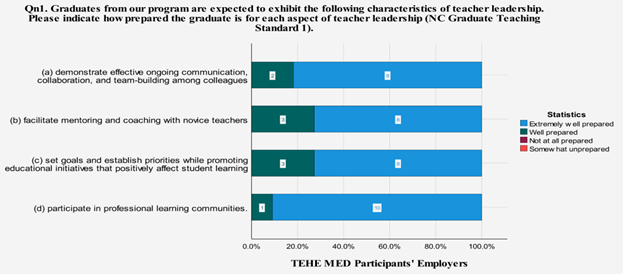
Chart depicting the TEHE MED Program participants’ preparedness in different aspects of Teacher Leadership
Figure 1: TEHE MED Program participants’ preparedness in different aspects of Teacher Leadership

It is noted also that one item in the third Graduate Teaching Standard showed significant variation compared to all the other items. Specifically, respondents rated participants’ integration of 21st century content into educational practice as nearly split in half (5 out of 11 respondents rated participants as extremely well prepared, while 6 out of 11 rated them as not extremely well prepared), indicating that almost half of the participants (i.e., 45.45%) may not be as well prepared to model the integration of 21st century content and skills into educational practice. On a positive note, over 80% of respondents noted that participants demonstrated in-depth knowledge of curriculum, instruction, and assessment, and 72.73% rated participants as extremely well prepared in developing relevant and rigorous curriculum (See Figure 3 below).

Figure 3: TEHE MED Program participants’ preparedness in aspects of Content and Curriculum expertise

A trend similar to this is noticed in the fourth standard, which evaluates participants’ preparedness in various aspects of student learning (See Figure 4 below). Just 63.6% of the participants are exceedingly competent in seeking out and utilizing existing research to inform school practices, and in designing action research to improve student learning and school policies and practices. This implies that almost 36.4% of the participants may not be as strong in these domains. However, in the same fourth standard, over 90% of the participants exhibit a remarkable level of competence in modeling technology integration to support student learning. Additionally, 72.7% of the participants possess the ability to critically analyze student and school performance data to ascertain needs and  plan rigorous, coherent, and substantial instruction.

Figure 4: TEHE MED Program participants’ preparedness in aspects of Content and Curriculum expertise

3.0 Conclusion and Recommendations

The pilot survey was conducted to a small number of people, and it received a considerable response rate. Findings from a pilot survey has revealed the effectiveness of the TEHE MED program in preparing its graduate teaching participants. Furthermore, the survey has identified some areas that require improvement or attention when designing the curriculum and lessons for the program participants. While the ratings were consistent across all items, indicating that the majority of program participants are highly skilled in the five teaching standards, the small sample size makes it challenging to determine the reliability of the pilot survey results.  Therefore, considering the encouraging response rate, it is recommended that the office of Educational Assessment employ other qualitative methods, e.g., employer in depth interviews and/or focus group discussions to gather an in-depth understanding of the participants’ preparedness in the 5 standards. This will improve the validity and reliability of the pilot survey findings and, as a result, improve the program and its future undertakings.

UNCG Educator Preparedness
2025 Interview Report 
Prepared for Dr. Christina O’Connor
Prepared by Dr. Tiffany Tovey and the OAERS Seminar Class, Spring 2025
Oluchi Anyaibe, Mercy Blematessa, Hannah Johnson, Bradley Madden, Eunice Oduro, Siphelele Qwabe, Brian Strickland, and Tippu Sultan
 

UNCG Educator Preparedness
2025 Interview Report

Purpose of this inquiry
The Office of Assessment, Evaluation, and Research Services at the University of North Carolina at Greensboro conducted an evaluation study to gather qualitative evidence on employer satisfaction with the preparation and performance of UNCG School of Education graduates from advanced-level educator preparation programs. This effort responds to Council for the Accreditation of Educator Preparation Standard A.4.1, which requires educator preparation providers to demonstrate that employers find program completers adequately prepared for their assigned responsibilities. Findings will inform both accreditation reporting requirements and ongoing programmatic improvement efforts across advanced licensure pathways.

Questions guiding the inquiry
We were interested in answering the following evaluation questions:

  • What are school leaders’ perceptions and experiences regarding how well UNCG graduates are prepared for the demands of teaching?
  • Based on school leaders’ perspectives, what improvements should be made to UNCG’s teacher preparation programming to better support future graduates?

Method: What did we do?
This study employed a qualitative interview process with principals and supervisors as the primary method of data collection to yield rich, actionable insights. We developed a semi-structured qualitative tool to gather perceptions about the effectiveness and readiness of graduates from the University of North Carolina at Greensboro’s (UNCG) advanced teaching programs. The protocol was developed for use with school-based personnel (e.g., principals, supervisors) who have directly worked with program graduates. The entire OAERS Seminar class assisted with data collection for this project (n = 8) as a part of a practical experience for learning more about the practicalities of qualitative inquiry. Graduate assistants worked in pairs to conduct the interviews, take notes, clean the data, and review, summarize, and synthesize the findings.
During the interview, we first oriented the conversation by inviting participants to describe their role and their school context, including how they have interacted with the UNCG graduate(s) in question. The core of the interview focused on the employer’s assessment of the graduate’s readiness for advanced teaching responsibilities. Participants were encouraged to reflect on specific strengths, areas of effective preparation, and any challenges or gaps they have observed.
Midway through the interview, participants were shown a screen with the five professional standards that guide advanced teacher preparation in North Carolina: (1) Teacher Leadership, (2) Respectful Educational Environments, (3) Content and Curriculum Expertise, (4) Student Learning, and (5) Reflection. These standards served as both a reflective prompt and a framework for deeper discussion. Participants were asked whether any of the standards resonated, either as particular strengths or areas needing growth, and to share examples that bring these standards to life. The interview concluded by asking about broader challenges faced, recommendations for improving teacher preparation, and any additional reflections the participant had.

Interview participants
We received a list of 13 employers’ emails from Dr. Christina O’Connor of MEd and Add-On candidates who graduated between Fall 2022 and Spring 2024, along with the associated UNCG graduate(s) that were employed in their school. These 13 employers represented 15 total graduates, including six masters degree graduates and nine add-on licensure recipients. Of this initial list, we reached out via email three times to each employer, resulting in six total interview conversations with employers that represent Guilford County Schools (n=2), Rockingham County Schools (n = 1), Currituck County Schools (n = 1), Rowan-Salisbury Schools (n = 1), and the North Carolina Cyber Academy (n = 1). Of the six principals, three represented elementary schools, two represented middle schools, and one represented the Cyber Academy.
Analysis and findings
The OAERS Seminar students cleaned and reviewed the data, created targeted summaries of the data based on our evaluation questions, and then reviewed the summaries, comparing each participant’s perspective to the other in order to provide a comprehensive, detailed narrative regarding teacher preparedness for graduates of UNCG and areas to consider as we refine our programming at the University in the future. In analyzing the data from the interviews, it became apparent that the responses about improvements that should be made to programming were referring broadly to UNCG’s teacher preparation programs rather than to the advanced preparation programs that specifically prepared the candidates they supervised. In future iterations of this process, we will revise the protocol to focus the questions more specifically on the programs in question. Findings are organized based on evaluation question in the pages to follow.
FINDINGS
What are school leaders’ perceptions and experiences regarding how well UNCG graduates are prepared for the demands of teaching?
School leaders perceive UNCG graduates as highly prepared for teaching, praising their skills, mindset, and leadership qualities.

Across the interviews, principals offered enthusiastic praise for UNCG graduates, frequently affirming that the teacher preparation program equips candidates with the skills, mindset, and leadership needed for success in diverse school contexts. Graduates were consistently described as well-prepared, particularly in areas such as curriculum knowledge, lesson planning, instructional delivery, and alignment with state standards. In this section, we first outline school leaders’ perceptions of graduates’ preparedness through the five North Carolina teaching standards, then we highlight two additional competencies that surfaced through our interviews. We end this section with challenges that graduates are facing in NC classrooms, according to our interviewees.
UNCG preparedness through the five standards


Teacher Leadership: Many school leaders recognized the leadership qualities of UNCG graduates, noting their ability to support colleagues and take on leadership roles within the school. Graduates were praised for their contributions to school-wide initiatives, such as PBIS Committees and mentorship programs.
In terms of interpersonal skills, graduates were recognized for their humility, reliability, and emotional intelligence, building meaningful connections with students and offering support to beginner teachers. One participant noted the emotional and morale-based mentorship a graduate provided, sharing that she is “very good at her teacher leadership because she in, in addition to being caring to the kids she cares about the school as a whole and cares about the BTs as people.”
 
Respectful Educational Environments: The respectful educational environments standard stood out most consistently across interviews. Many principals emphasized the graduates’ ability to form meaningful relationships with students, parents, and colleagues. This includes effective communication and engagement with families. Graduates were praised for fostering inclusive and supportive classroom cultures, ensuring that all students feel valued and respected. A principal recounted, “She communicates with her families a great deal, great communication via Class Dojo. She also has their telephone numbers, she’s not afraid to call them to share growth and also share areas of need.” The graduate’s commitment to fostering a respectful and inclusive classroom was evident in her proactive communication with parents and her intentional efforts to involve them in their children’s education.
Content and Curriculum Expertise: Several principals highlighted the strong content knowledge of UNCG graduates. They noted that graduates are well-prepared in understanding and delivering curriculum content effectively and are able to align their teaching with state standards and curricular goals (including vertical alignment across grade levels to ensure continuity in student learning). One principal shared an example of a teacher who demonstrated exceptional content and curriculum expertise, reflecting, “So as far as curricular knowledge, how to plan the constraints of a lesson, all those things are taught here like she knows how to look at standards. She knows how to do those things.” Her strong grasp of the curriculum allowed her to implement a new literacy program, Youfly, and make it relevant and engaging for her students.


Student Learning: Many principals emphasized the graduates’ strong focus on student learning. They noted that graduates are adept at tailoring their instructional strategies to meet diverse needs, engage students, and differentiate instruction. This includes using innovative tools and methods to make learning more interactive and personalized. A principal reflected, “She adapts and goes the extra mile to make sure that our students have what they need.”
 
Several principals also highlighted the graduates’ efforts to support English Learners (ELs) through targeted instructional strategies and resources. A principal recounted a time that a graduate was working through engaging ELs in instruction, “She had them going in all the centers and I think that the program has helped her think about that—think about the needs of our Hispanic populations—or English Learners (ELs).” The principal noted that her ability to create engaging and differentiated learning experiences for her students was evident in her use of centers to support language development. She also organized ESL Family Nights to help families access resources, demonstrating a holistic approach to student and family engagement.


Reflection: Several principals described UNCG graduates as reflective and coachable, consistently seeking feedback and looking for ways to improve their practice. Graduates were noted for their receptiveness to coaching and their willingness to incorporate feedback into their teaching strategies.

One principal described their graduate as “definitely very reflective in her practice, she’s always going to the CF, asking how she could be better. And we’re providing her with feedback. But she’s very receptive of the feedback that we give her and making whatever adjustments that needs to be made.”
 
Adaptability and flexibility. Many school leaders praised UNCG graduates for their ability to adapt to different roles, grade levels, and teaching methods. This adaptability is crucial in meeting the diverse needs of students and adjusting to various educational environments. One interviewee reflected on the flexibility of her graduate, “She has taught English for me, Math and Science for me. And then this year, she works with my English as a Second Language (ESL) students.”
 
Use of technology. Several principals emphasized the graduates’ ability to integrate technology effectively, mentioning tools like Nearpod and AI applications, and to adapt instruction to meet student needs in both traditional and virtual settings. One teacher was praised for using the Magic School app to make virtual learning more creative and engaging.


Overall, the data suggest that UNCG graduates are entering the field with strong foundational skills across multiple standards and competencies. One interviewee shared, “UNCG does a very good job of preparing teachers with that strong background, in just good instructional practices, and they are thinkers and problem solvers too, with a strong student focus.”
 
Challenges teachers are facing. During the interviews, we inquired into the biggest challenges these teachers face, from the supervisors’ perspective. Teachers are currently navigating a complex landscape marked by emotional, systemic, and instructional challenges. A major concern across interviews was classroom and behavioral management, particularly with students experiencing poverty, trauma, or other socio-emotional stressors that manifest as distractions or disruptions. They also expressed difficulty engaging students in online settings, where home environments often introduce uncontrollable distractions that further complicate the learning process.
Systemic pressures, especially those stemming from the COVID-19 pandemic, continue to weigh heavily on educators. Learning loss, fluctuating attendance, and the need to manage multiple learning levels within a single classroom have intensified teacher workloads, according to our interviews. Compounding these issues is a reduction in resources such as tutoring support, as well as emotional burdens tied to changing family dynamics. Interviewees described parents as more reactive and less trusting, adding strain to teachers already working long hours and facing a broader societal trend of diminishing respect for the profession. Additional challenges include teaching multiple core subjects under stringent standards, working with highly transient student populations (especially English Learners), and coping with fatigue, low energy, or long commutes, all of which impact consistency, morale, and teacher-student relationships.


Based on school leaders’ perspectives, what improvements should be made to UNCG’s teacher preparation program to better support future graduates?

School leaders suggest that UNCG’s teacher preparation program could be improved by increasing exposure to high-need and diverse student populations, emphasizing adaptability and openness to innovation, enhancing classroom management and instructional strategy planning, integrating training for dual- exceptional and multilingual learners, supporting non-traditional teacher pathways, and offering mock interviews and job preparation experiences.

While many participants did not identify significant gaps in the graduates’ preparation and praised their overall readiness, some provided constructive feedback and suggestions for improvement. Several participants did not offer any criticism at all and were entirely positive about the preparedness of UNCG graduates. However, across a few interviews, principals pointed some areas for improvement, given the specific struggles the graduates in question faced and overall observations from their vantage point.
Based on the interview data, we have articulated the following areas for improvement and actionable recommendations for strengthening teacher preparation at UNCG.
Recommendations for strengthening UNCG teacher preparation
Enhance Classroom Management and Instructional Strategy Planning: Increase focus on classroom management strategies and instructional planning for differentiated, student-centered activities, including small group work and interactive learning experiences. One participant stressed this point around student-centered activities, such as small group work and interactive learning experiences. He shared, “Even your high-level kids, they want to do some smaller things so that it catches their attention better.”
 
Increase Exposure to High-Need and Diverse Student Populations: Ensure that graduates have opportunities to work in schools with diverse needs, including Title I schools, serving students with Exceptional Children (EC) needs, trauma histories, socioeconomic disadvantage, and Social Emotional Learning (SEL) needs.
One participant pushed the idea of practical experiences in diverse places, “I think putting them in real situations, putting them in schools like mine that have needs and not trying to hide them from the title one schools, the schools who have socioeconomic—the schools who have students with Exceptional Children (EC), because to be honest, after the pandemic, all schools are seeing an influx and they change in their population. So preparing them by letting them see the real, and not just textbooks. It’s because textbook examples of old are not our current reality when dealing with students.”
 
Emphasize Adaptability and Openness to Innovation: Foster a mindset of adaptability and openness to new tools and methods, especially with the rise of technology and artificial intelligence (AI) in education. A principal emphasized this, recommending explicitly teaching adaptability and openness to new tools and methods to enhance student engagement.
Integrate Training for Dual-Exceptional and Multilingual Learners: Provide more training and resources for working with students who have dual exceptionalities, such as gifted and learning disabled, and ESL. One participant reflected that current approaches are too siloed, failing to equip teachers with strategies that address intersecting student needs.

 
Support for Non-Traditional Teacher Pathways: From a school operating under a flexible licensure model, one participant recommended creating modular or targeted coursework for content experts without formal teacher training. This could include short-term hands-on training in pedagogy for individuals with subject-area degrees.
 
Offer Mock Interviews and Authentic Job Preparation Experiences: While noting overall preparedness, one principal recommended the addition of mock interviews and job-readiness support that encourages candidates to reflect deeply on their own philosophies and practices, moving beyond generic or rehearsed responses.

The MEd in Special Education planned to conduct a pilot survey of employers in Spring 2023, however the number of completers over the past three years was so low that a survey was unlikely to produce sufficient data to be useful. Therefore, the program faculty conducted a focus group for employers on May 9, 2023.  Results from the focus group are reported below. The MEd in Special Education has been discontinued and is no longer enrolling new candidates effective summer 2024.    

Methodology

We sent emails to 17 principals who employed our graduates. We received responses to the email from 4 principals. Two principals participated in the data collection effort—one via a Zoom meeting and one by email and phone.

Guiding Questions for Employer Focus Group (M.Ed. Alum)

These guiding questions were generated from the survey used to determine how employers rate the preparedness of M.Ed. candidates who pursued a degree in advanced licensure in special education and are or have been employed in the employer’s district or school.

There are five broad areas that align with professional standards for advanced licensure programs. We’ll ask a guiding question for each one to solicit your input on how prepared you feel the candidate demonstrates evidence of knowledge and skills in each area as a teacher with advanced licensure. Although you may also employ graduates of our initial licensure program in special education (undergraduates with a bachelor’s degree), the focus here should be exclusively on the advanced licensure candidates.

Teacher Leadership

In terms of demonstrating teacher leadership, what are your thoughts on how the candidates assume the role of teacher leader. How have candidates demonstrated any of the following attributes of a teacher leader?

  • Demonstrate effective communication, collaboration, and team building among colleagues.
  • Facilitate mentoring and coaching with novice teachers.
  • Promote educational initiatives that positively affect student learning.
  • Participate in PLCs.

Respectful Education Environments

As educators, we value a supportive, respectful environment. What can you tell us about how candidates demonstrate evidence of their abilities to create, nurture, and facilitate a respectful learning environment. (Prompt with bolded words as needed). Share with us some specific examples of how candidates do any of the following:

  • Facilitate the development of inviting, respectful, supportive, inclusive, and flexible educational communities.
  • Create collaborative partnerships with families, schools, and communities to promote a positive school culture.
  • Facilitate and model caring and respectful treatment of individuals within the learning community.
  • Demonstrate knowledge and understanding of diverse world cultures and global issues.
  • Encourage high expectations for all students.
  • Collaboratively design and implement curriculum and instruction that is responsive to learner differences.

Content and Curriculum Expertise

Pertaining to content and curriculum expertise, what are your thoughts on how the candidates you’ve employed have demonstrated or have been prepared to:

  • Demonstrate in-depth knowledge of curriculum, instruction, and assessment.
  • Model the integration of 21st century content and skills into educational practices.
  • Develop relevant, rigorous curriculum.

Student Learning

How do you feel about the preparedness of the candidates you’ve employed to focus on student learning and outcomes in a critical and analytical way.  Specifically, how candidates:

  • Seek out and use existing research to inform school practices.
  • Design (use) action research to investigate and improve student learning and school policies and practices.
  • Model technology integration that supports student learning.
  • Critically analyze student and school performance data to determine needs and plan instruction that is rigorous, coherent, and substantiated within a theoretical and philosophical base.

Reflection

Reflective practice is part of having a growth mindset and engaging in ongoing professional development. What can you tell us about how candidates you have employed demonstrate actions associated with reflective practice. (“Things such as . . .”).

  • Promote an educational culture that values reflective practice.
  • Model the development of meaningful professional goals.
  • Model personal and professional reflection to extend student learning and school improvement.

Findings. Here are responses and general themes that emerged from the two respondents. The responses are organized and presented as they relate to each of the five broad areas that align with professional standards for advanced licensure programs.

Teacher Leadership

  • Collaborate well
  • Discuss student data to determine next steps for instruction and student growth
  • Attend PLCs and participate
  • Mentor novice teachers
  • Supervise student teachers and interns
  • Serve as model for other teachers; DPI has observed to see one teacher in action.
  • Led a group lesson study discussion with grade level team and other teams
  • Belongs to a professional organization and shares resources and learnings with other teachers

Respectful Education Environments

  • Holds high expectations for students
  • Advocates for students and helps them advocate for themselves
  • Establishes and maintains a safe and nurturing classroom
  • Communicates with parents
  • Collaborates with parents
  • Demonstrates support for parents during the referral and initial placement process
  • Relies on data to make decisions, but maintains nurturing attitude
  • Demonstrates knowledge of how to arrange a supportive environment for students

Content and Curriculum Expertise

  • Serves as the source of information to help solve behavior issues and identify next steps
  • Teaches reading based on the science of reading
  • Embeds technology into instruction
  • Mentors an adaptive curriculum teacher to work through a curriculum program

Student Learning

  • Demonstrates knowledge of the science of reading and how it impacts student learning
  • Seeks opportunities to learn more about how to impact student learning
  • Listens to podcasts about learning
  • Uses data regularly to inform teaching
  • Sets appropriate goals for students and monitors progress
  • Problem solves to facilitate student growth when progress is slow

Reflection

  • Analyzes situation to determine if qualification for special education is the result of teaching rather than a disability
  • Engages in reflective practice
  • Demonstrates a phenomenal skill set
  • Thinks outside the box and tries different things
  • Reads articles and shares with colleagues

Conclusions

It may be difficult to draw too many conclusions based on two participants’ responses. Nonetheless, the responses reflect that the principals think the candidates are well prepared to teach following their advanced program

Next steps

  • Establish a system for tracking candidates’ placements and their principals’ names
  • Ensure that candidates’ alternative email addresses are obtained to verify where they are teaching
  • Consider incentives to encourage more participation in the process of soliciting input from principals about candidates’ preparedness
  • Revisit the interview questions and adjust to ensure they are capturing the most important information that may impact program improvement

BKISED Advanced Teaching License Graduate and Employer Survey Report 

April 2025 

Introduction 

The Birth through Kindergarten Interdisciplinary Studies in Education and Development (BKISED) Masters program includes a concentration that leads to the Birth through Kindergarten Advanced or M License. An annual survey is conducted of graduates who completed the program two to three years prior. A survey is also disseminated to graduates’ employers to document their professional position and progress, as well as their employers’ satisfaction with their preparation to provide high quality early education services. This report summarizes data collected in Spring 2023 and 2024, in partial fulfillment for CAEP requirements and also to support program improvements. 

Methodology 

The data collection instrument was a survey designed to collect data on graduates’ current positions and the perception of their preparedness for various standards-related skills and knowledge. Implemented through Qualtrics, the survey asked questions about the organization the graduates work for, the position that they currently hold, and the children/families that they work with. The survey also asked for respondents to rate graduates’ preparedness on a variety of items developed based on the North Carolina Department of Public Instruction Standards for Graduate Teacher Candidates and informed by expectations articulated in the National Association for the Education of Young Children (NAEYC) Professional Standards and Competencies for Early Educations and the Division for Exceptional Children (DEC) Initial Practice-Based Professional Preparation Standards for Early Interventionists/Early Childhood Special Educators. Respondents rated the graduates’ preparedness on a three-point scale (“well prepared”, “somewhat prepared” and “not prepared”), with an option to indicate that the specified skill/knowledge was not required for their position. Graduates were asked to rate their perception of their own level of preparedness and employers were asked to rate their evaluation of the graduate’s preparedness. Ratings on the scale were recoded so that “well prepared” was scored as a 3. 

Graduates from 2020 to 2022 were surveyed. Each graduate from this respective period was contacted via email to request participation in the survey and to ask for their direct supervisor’s contact information so that the program could request that the employer complete a survey. A total of nine graduates were contacted and all nine agreed to participate. They all provided their supervisor’s contact information, and all nine supervisors invited to participate completed a survey. All but one graduate (88.9%) reported being employed with the same organization prior to graduating from the program. The one graduate who joined their current organization after graduation had been employed with the entity for approximately one year and nine months.  

Nine employers were surveyed and all nine submitted survey responses. Each employer respondent was the direct supervisor of the graduate for whom they completed the survey. The employer respondents included three principals, two program directors, two educational services coordinators, one Academic Dean and one educational diagnostician clinical supervisor.  

Results 

Graduate Work Settings and Positions 

All of the graduates (N = 9) reported being employed in the early childhood education field. They work for a variety of programs including NC Pre-K (n = 4), public schools (n = 5), Head Start/Early Head Start program (n = 3), and Early Intervention (n = 2). Note that an individual respondent could select multiple programs because they might, for instance, work in an NC Pre-K classroom within a public school setting or in a Head Start setting.  

All graduates but one reported that they work directly with families and children. The number of children/families that the graduates work with ranged from 10 to 400, with a mean of 63.1 children/families. However, seven of the eight who work directly with children and families reported that they work with 22 or fewer children/families. One graduate works with infants and toddlers, four with preschool/pre-Kindergarten age children, two with kindergarten and one with elementary school-age children.  

The graduates’ position titles included: Lead Teacher (n = 5; two at the preschool/Pre-K level and three kindergarten), Intervention Specialist—Preschool, Early Childhood Education Supervisor, Educational Diagnostician, and School Readiness Coach. These position titles indicate that the graduates are fulfilling a variety of roles and different types of responsibilities within the field of early childhood education and early childhood special education. All graduates described their current position as mid-level or higher within their program, and two described their current position as an advanced-level position. Employers were also asked to rate the level of the graduate’s position. Seven indicated that the graduate was currently in a mid-level position; one supervisor indicated that the graduate that they supervise was in an entry-level position, and one indicated that the graduate’s current position was an advanced level position. Graduates were asked to indicate whether they have been promoted within their program since graduation. Four indicated they had been promoted and five indicated that they have not been promoted because there has not been an opportunity to be promoted since they graduated.  

Perceptions of Graduates’ Preparation 

Graduates and employers were asked to rate their perception of the preparedness of the graduates on a variety of items related to effective teaching on a scale of one to three, with a rating of three indicating “well prepared”. Table 1 shows that graduates and employers felt that the graduates were well prepared to demonstrate leadership and promote respectful educational environments. Graduates reported being somewhat less prepared to facilitate mentoring or coaching with colleagues and to participate in professional organizations. Graduates indicated that they felt well prepared to meet the expectations presented in the other items. Employers indicated that the graduate that they supervise is well prepared for each of the aspects of leadership and respectful educational environments that were measured on the survey, although their responses indicated they felt the graduates were somewhat less prepared to facilitate mentoring or coaching with colleagues.  

Table 1: Graduates’ and Employers’ Perception of Preparedness for Leadership and Respectful Educational Environments 

 Graduates Employers 
Item Mean Range Standard Deviation Mean Range Standard Deviation 
Demonstrate effective, ongoing communication with colleagues. 3.0 3.0 
Facilitate mentoring and coaching with teachers/colleagues. 2.88 2 – 3 .31 2.88 2-3 .31 
Demonstrate leadership to promote improved outcomes for young children and their families. 3.0 3.0 
Engage in collaborative learning opportunities to improve your practice. 3.0 3.0 
Participate in local, regional, and/or national professional organizations/activities. 2.78 2 – 3 0.42 N/A* N/A* N/A* 
Create and/or support collaborative partnerships with colleagues. 3.0 3.0 
Demonstrate caring and respectful interactions with individuals within the educational community. 3.0 3.0 
Collaborate as a partner with families to support respectful, culturally responsive, and reciprocal relationships. 3.0 3.0 
Implement learning experiences that are responsive to individual learner differences 3.0 3.0 

*Employers were not asked to rate this item. 

Regarding their perception of how well prepared graduates were to plan and implement an effective early childhood curriculum and to use results from screenings and assessments, the graduates indicated that they generally felt well prepared. Graduates indicated that they felt somewhat less prepared to plan, implement and evaluate a curriculum and ratings of their knowledge of formal and informal assessments were someone lower, but all graduates felt “well prepared” in their knowledge of screening tools and processes. Employer ratings of graduates’ preparedness in curriculum and assessment indicated they felt all graduates were “well prepared” to implement and evaluate early childhood curricula, but their ratings for screening tools/processes and assessments were somewhat lower, with a mean of 2.78 for the items related to screening and assessments.  

Table 2: Graduates’ and Employers’ Perception of Preparedness for Implementation of Curriculum and Assessment 

 Graduates Employers 
Item Mean Range Standard Deviation Mean Range Standard Deviation 
Demonstrate in-depth knowledge of how to plan, implement and evaluate curriculum and learning experiences appropriate for young children. 2.88 2-3 .31 3.0 
Demonstrate in-depth knowledge of screening tools and processes to identify children with potential disabilities. 3.0 2.78 2 – 3 .42 
Demonstrate in-depth knowledge of formal and informal assessments for instructional planning and progress monitoring. 2.78 2-3 .42 2.78 2 – 3 .42 

Table 3 shows that graduates indicated that they felt well prepared to facilitate student learning and reflective practice. Graduates rated the use of up-to-date research to inform practice, and the use of technology for teaching and for communication were rated somewhat lower by the graduates than the other items, all of which were rated as “well prepared” by all graduates. Employers rated graduates slightly less prepared across many of these items. Mean ratings of preparedness were 2.78 to 2.88 on all items but one. Employers rated graduates’ ability to promote reflective practices higher than the other items, consistently reporting that the graduate was “well prepared” on this item.  

Table 3: Graduates’ and Employers’ Perceptions of Preparedness to Facilitate Student Learning and Reflective Practice 

   
Item Mean Range Standard Deviation Mean Range Standard Deviation 
Use up-to-date research to inform your practice. 2.88 2 – 3 .31 2.78 2-3 .42 
Systematically collect and analyze multiple sources of data from children, families, and/or their program to improve your practice and child/family/program outcomes. 3.0 2.78 2 – 3 .42 
Promote the use of technology to support children’s learning. 2.88 2-3 .31 2.88 2 – 3 .31 
Promote the use of technology to communicate and collaborate with families and other professionals. 2.88 2-3 .31 2.78 2 – 3 .42 
Promote an educational culture that values reflective practice to extend children’s learning and for program improvement. 3.0 3.0 
Promote the development of meaningful professional goals to improve professional practices. 3.0 2.78 2 – 3 .42 

Potential Limitations 

There are some potential limitations to this effort to document graduates’ strengths and areas for improvement, as well as employers’ satisfaction with the graduates whom they supervise. First, the small sample size limits the program’s ability to draw conclusions from the results. Generally, these graduates and their employers seem to be satisfied with the graduates’ performance, but with a sample of only none graduates and their supervisors the results do not support strong conclusions regarding the preparation of graduates. Although there was 100% participation—all eligible graduates and their employers participated—the sample is small.  

A second limitation is the lack of variation in responses to the items. Most of the items were rated as “well prepared” by respondents. This lack of variation presents additional challenges in drawing conclusions regarding areas where the program can seek to improve preparation of current candidates. For future surveys, the program should consider using a five-point scale to elicit greater variance among the responses.  

Finally, although graduates were asked to report the length of time they have been working with their current organization and to identify their direct supervisor, the survey did not collect data regarding how long the employer respondent has been the graduate’s supervisor nor how regularly the employer can observe the graduate in their professional practice. Collecting data on these two indicators—how long the graduate has worked for the employer and how regularly the employer observes and/or interacts with the graduate—would provide an indication of how well the employer might know the graduates’ work from first-hand experience. This might be an important factor in the employers’ ability to gage how satisfied they are with the graduate and could be an important additional data point to collect in the future. 

Conclusion 

Overall, graduates from the BKISED Leadership & Advanced Teaching License program report that they are doing well two to three years after graduation. Results suggest that graduates have been successful in retaining their positions and in receiving promotions when available. Both graduates and their employers rated the graduates as well prepared on items that are related to North Carolina’s Standards for Graduate Teaching Candidates

Potential areas of improvement based on the ratings include strengthening the program’s emphasis on preparing students to facilitate coaching and mentoring with other teachers. The program has created a new course on coaching which is being offered for the first time in Spring 2025. Future graduates have the opportunity to take this course as an elective. The program is also strengthening the focus on research in several courses and continuing to evaluate the SES 603 course on screening and assessment to strengthen content related to formative and instructional assessments. Results from the survey of graduates and employers inform program decisions in these areas.   

This set of assessments aligns to CAEP Annual Report Measure 3: Candidate competency at completion (Component R3.3), specifically for initial level programs.


UNCG initial level programs use multiple measures to determine if teacher candidates are ready for the profession. See the following links and data tables for a summary of these data.
Licensure Exams
Initial teaching candidates must successfully pass one or more standardized exams to qualify for a North Carolina teaching license. The NC Department of Public Instruction maintains a data dashboard that allows you to examine performance on licensure exams. Go to the dashboard[MM1] , select “License Exams” from the array of options. Select an exam from the tabs at the top of the page (the default aggregates all exams). Next, select “UNCG” for our institution. You can select all years of data, the most recent year, or the last three years. UNCG pass rates are comparable to the state overall. Both UNCG and the statewide pass rates have trended down over the past three years.
For data on individual tests, the Federal Title II reporting process collects pass rates on these exams into one data report. See our most recent Title II report for Traditional Programs [MM2] and Alternative Programs. [MM3] Note that pass rates are only given for licensure categories where there are at least ten graduates for privacy reasons. The key measure for each licensure exam is the Pass Rate column – the right-most column in the data tables.
edTPA
The teaching performance of UNCG candidates is assessed summatively using the edTPA. The edTPA is a nationally normed proprietary performance assessment of planning, instruction and assessment, aligned to the InTASC standards. The edTPA consists of three tasks. Each task is assessed using 4 or 5 rubrics. Most programs at UNCG complete 15-rubric assessments. The only exception is World Languages French and Spanish), which is a 13-rubric assessment. Each rubric is scored on a scale of 1-5 and the rubric scores are added together for a total score on the assessment. The state of North Carolina considers a total score of 38 to be a passing score. The data presented represent all program completers and were collected during their student teaching semester (either fall or spring).

Year  Number of candidates completing initial program  Number of candidates taking assessment  Average score  State passing score  
2021-22  270 268 42.4  38
2022-2322422443.1
2023-2418518543.3

Candidates’ average scores on the edTPA exceed the state required score across three cycles of data, with the three-year trend increasing slightly. The edTPA data show that UNCG candidates are assessed using a nationally normed performance-based assessment and that candidates demonstrate the knowledge, skills and dispositions that are associated with a positive impact on the learning and development of P-12 students.
Teacher Candidate Evaluation Rubric
The Teacher Candidate Evaluation Rubric (TCE) is a proprietary assessment instrument designed by McREL for the state of North Carolina. It is used to assess candidate performance on the NC Professional Teaching Standards and is completed by university-based and field-based clinical educators.

  • Standard 1 of the TCE measures how well teacher candidates demonstrate leadership.
  • Standard 2 of the TCE measures how well teacher candidates establish a respectful environment for a diverse population of students.
  • Standard 3 measures how well teacher candidates know the content they teach.
  • Standard 4 measures how well teacher candidates facilitate learning for their students.
  • Standard 5 measures how well teacher candidates reflect on their practice.

Each element of the TCE rubric is scored on a scale of 1-4. A score of 3 is identified as proficient. Each standard has multiple elements. The chart below presents the average scores for each standard.

Year  Number of candidates  Average of TCE-S1  Average of TCE-S2  Average of TCE-S3  Average of TCE-S4  Average of TCE-S5  
2021-22 274  3.263.313.233.283.24
2022-232243.183.243.183.183.17
2023-241853.193.243.173.173.18

Across three cycles of data, UNCG candidates meet or exceed the proficient level on all 5 NC Professional Teaching Standards as measured by the Teacher Candidate Evaluation rubric.
 
Candidate Dispositions Assessment Process
The Candidate Dispositions Assessment Process 2.0 (CDAP 2.0) was developed at UNCG by a collaboration of assessment experts and faculty members, resulting in an assessment instrument intended to provide actionable information to faculty and to help teacher candidates understand how to successfully demonstrate dispositions that meet professional standards. The UNCG Dispositions Rubric is intended to measure dispositional strengths and weaknesses of teacher candidates. Dispositions are important to a teacher’s success; therefore, scores on the UNCG Dispositions Rubric are intended to be a critical component of decisions regarding a teacher candidate’s recommendation for licensure. The Dispositions rubric is scored from 0-3, with a score of 2 as proficient. Candidates must be rated as proficient (score of 2) on all of the Dispositions in order to be recommended for licensure.

Year  Number of candidatesAverage of EthicalAverage of ResponsibleAverage of ReflectiveAverage of ReceptiveAverage of CollaborativeAverage of CommittedAverage of RespectfulAverage of EquitableAverage of Advocacy
2021-22 274 2.332.412.332.362.282.362.332.312.28
2022-23224 2.262.322.232.252.212.242.242.212.21
2023-241852.292.352.292.332.252.332.302.242.27

Across three cycles of data, candidates met or exceeded the proficient level for all dispositions at the final time point.

This set of assessments aligns to CAEP Annual Report Measure 3: Candidate competency at completion (Component RA3.4)

MSA/PMC in School Leadership

There are 7 standards evaluated on the NC School Executive Evaluation Rubric for Preservice Candidates. Candidates are rated from 1-4, with a score of 3 being Proficient. Across three cycles of data, candidates performed at or above the proficient level on all standards.

Ratings from The North Carolina School Executive Evaluation Rubric 

 2021-22 2022-232023-24
Standard N Average Score NAverage Score NAverage Score
Standard 1. Strategic Leadership 36 3.14 173.0353.17
Standard 2: Instructional Leadership 36 3.2 173.0353.20
Standard 3: Cultural Leadership 36 3.29 173.0353.21
Standard 4: Human Resource Leadership 36 3.26 173.0353.14
Standard 5: Managerial Leadership 36 3.14 173.0353.17
Standard 6: External Development Leadership 36 3.17 173.0353.11
Standard 7: Micro-political Leadership 36 3.46 172.94353.14

MEd in Teacher Education

On both the Teacher Leadership Project Rubric and the Teacher Research Project Rubric, candidates receive a score of Exceeds Expectations (3), Meets Expectations (2), or Does Not Meet Expectations (1) on each element of the rubric.  Across three cycles of data, candidates met or exceeded the expectations on all elements of both rubrics.

MEd in Teacher Education Teacher Research Project Data

  2021-22 2022-232023-24
Indicator Standards Assessed N Average Score N Average Score NAverage Score
Demonstrate in-depth knowledge of curriculum, instruction, and assessment. NC Standards for Graduate Teacher Candidates S3 11 2.55 3.072.71
Seek out and use existing research to inform school practices. NC Standards for Graduate Teacher Candidates S4 
 
CAEP A.1.1 Use of research and understanding of qualitative, quantitative, and/or mixed methods research methodologies 
11 2.73 2.8972.71
Design: Candidate clearly articulates research questions that are open-ended, focused AND situated or contextualized by literature/previous research  NC Standards for Graduate Teacher Candidates S4 
 
CAEP A.1.1 Use of research and understanding of qualitative, quantitative, and/or mixed methods research methodologies 
11 2.36 2.8972.86
Design: Candidate clearly describes research contexts and study participants (e.g., number of participants, demographics, current level of performance, grade level, prior experiences ) in a way that is relevant to the research question and situates study contexts within literature/previous research NC Standards for Graduate Teacher Candidates S4 
 
CAEP A.1.1 Use of research and understanding of qualitative, quantitative, and/or mixed methods research methodologies 
11 2.45 2.7873.0
Design: Candidate describes how data were collected (e.g., number of interviews, interview questions, protocols) in a clear and detailed way AND connects data collection method to research question AND includes multiple data sources (e.g., data triangulation) NC Standards for Graduate Teacher Candidates S4 
 
CAEP A.1.1 Use of research and understanding of qualitative, quantitative, and/or mixed methods research methodologies 
11 2.91 2.7872.71
Design: Candidate describes how each source of data was analyzed in a clear and detailed way AND includes rationale for using particular methods of analysis to answer the research question(s). NC Standards for Graduate Teacher Candidates S4 
 
CAEP A.1.1 Use of research and understanding of qualitative, quantitative, and/or mixed methods research methodologies 
11 2.27 2.4472.57
Design: Candidate comprehensively and accurately identifies and discusses potential limitations of the study (e.g., accurately identifies and discusses  potential limitations of study findings)  NC Standards for Graduate Teacher Candidates S4 
 
CAEP A.1.1 Use of research and understanding of qualitative, quantitative, and/or mixed methods research methodologies 
11 2.55 93.073.0
Analysis: Candidate comprehensively  and accurately articulates the results of data analysis in response to the research question(s) NC Standards for Graduate Teacher Candidates S4 
 
CAEP A.1.1 Applications of data literacy 
11 2.55 92.6772.71
Analysis: Candidate supports claims about student and school performance with evidence from the study. The candidate synthesizes and contextualizes results from the study with prior research/literature. NC Standards for Graduate Teacher Candidates S4 
 
CAEP A.1.1 Applications of data literacy 
11 2.64 2.5672.43
Determine needs and plan instruction that is rigorous, coherent, and substantiated within  a theoretical and philosophical base.  NC Standards for Graduate Teacher Candidates S4 
CAEP A.1.1 Employment of data analysis and evidence to develop supportive school environments 
11 2.55 92.7872.86

MEd in Teacher Education Teacher Leadership Project Data

  2021-22 2022-232023-24
Indicator Standards Assessed N Average Score N Average Score NAverage Score
Sets goals and establishes priorities while promoting educational initiatives that positively affect student learning:  Purpose and goals for teacher leadership project NC Standards for Graduate Teacher Candidates S1 
 
CAEP A.1.1 Leading and/or participating in collaborative activities with others 
 
CAEP A.1.1 Use of research 
11 2.82 3.0 72.71
Sets goals and establishes priorities while promoting educational initiatives that positively affect student learning:  literature about research and/or practices for student learning    NC Standards for Graduate Teacher Candidates S1 
 
CAEP A.1.1 Leading and/or participating in collaborative activities with others 
 
CAEP A.1.1 Use of research 
11 2.73 2.89 72.86
Establish a positive and productive environment for a diverse population of students, their families, and the community. NC Standards for Graduate Teacher Candidates S2 
 
CAEP A.1.1 Application of professional dispositions 
11 2.18 92.89 72.86
Demonstrate effective ongoing communication, collaboration, and team-building among colleagues. NC Standards for Graduate Teacher Candidates S1 
 
CAEP A.1.1 Leading and/or participating in collaborative activities with others 
 
CAEP A.1.1 Application of professional dispositions 
11 2.64 92.89 72.57
Promote educational initiatives by planning and implementing a project that positively affects student learning: Candidate presents a coherent plan that addresses the need(s) identified in a cohesive manner.  NC Standards for Graduate Teacher Candidates S1 
CAEP A.1.1 Employment of data analysis and evidence to develop supportive school environments 
11 2.55 72.86
Promote educational initiatives by planning and implementing a project that positively affects student learning: Candidate describes how the plan was implemented. NC Standards for Graduate Teacher Candidates S1 
CAEP A.1.1 Employment of data analysis and evidence to develop supportive school environments 
11 2.64 2.78 72.71
Contribute to systematic, critical analysis of learning: Evidence of feedback collected from stakeholders NC Standards for Graduate Teacher Candidates S5  
CAEP A.1.1 Employment of data analysis and evidence to develop supportive school environments 
11 2.55 2.56 72.71
Contribute to systematic, critical analysis of learning:  Reflects on the evidence collected from stakeholders NC Standards for Graduate Teacher Candidates S5  
CAEP A.1.1 Employment of data analysis and evidence to develop supportive school environments 
11 2.36 2.89 72.71
Model personal and professional reflection to extend student learning and school improvement. NC Standards for Graduate Teacher Candidates S5  
 
CAEP A.1.1 Application of professional dispositions 
11 2.27 3.0 72.86

MEd in Birth-Kindergarten Interdisciplinary Studies

The first three cycles of data for the Dispositions instrument are presented below. Due to the low number of candidates (N=2 for 2021-22, N=2 for 2022-23, N=3 for 2023-24), the data are aggregated across the three cycles. After piloting new Data Literacy and Collaboration project assessments, the program faculty redesigned their data collection strategy, and the first cycle of data is being collected in Spring 2025.

The Candidate Dispositions Assessment Process 2.0 (CDAP 2.0) was developed at UNCG by a collaboration of assessment experts and faculty members, resulting in an assessment instrument intended to provide actionable information to faculty and to help teacher candidates understand how to successfully demonstrate dispositions that meet professional standards. The UNCG Dispositions Rubric is intended to measure dispositional strengths and weaknesses of teacher candidates. Dispositions are important to a teacher’s success; therefore, scores on the UNCG Dispositions Rubric are intended to be a critical component of decisions regarding a teacher candidate’s recommendation for licensure. The Dispositions rubric is scored from 0-3, with a score of 2 as proficient.

CDAP 2.0 Average Scores for Birth-Kindergarten MEd Candidates 2021-2024

Years Number of candidatesAverage of EthicalAverage of ResponsibleAverage of ReflectiveAverage of ReceptiveAverage of CollaborativeAverage of CommittedAverage of RespectfulAverage of EquitableAverage of Advocacy
2021-24 2.542.492.392.622.482.432.432.502.29

MEd in Special Education General Curriculum

For the MEd in Special Education, data are collected from student artifacts (i.e., major assignments) in SES 647 (Teacher Leadership Project) and SES 652 (Action Research Project) beginning with Summer 2022. Between Summer 2022 and April 2025, nine candidates completed SES 647 and nine completed SES 652. Aggregated data for three years are reported below.

MEd in Special Education Action Research Project Data 2022-25

IndicatorsStandards AssessedNAverage Score
Demonstrate in-depth knowledge of comprehensive and challenging (e.g., general and specialized) curriculum, intensive, individualized, evidence-based instruction, and bias-free assessment.  CEC Advanced Standard 1.0 Special CEC Advanced Standard 2.0 NC Standards for Graduate Teacher Candidates S3  93.56
Seek out and use existing special education research to inform academic and behavioral support practices.CEC Advanced Standard 4.0   NC Standards for Graduate Teacher Candidates S4   CAEP A.1.1 Use of research and understanding of qualitative, quantitative, and/or mixed methods research methodologies    93.56
Design action research.CEC Advanced Standard 1.2   CEC Advanced Standard 4.0 NC Standards for Graduate Teacher Candidates S4 CAEP A.1.1 Use of research and understanding of qualitative, quantitative, and/or mixed methods research methodologies  93.44
Critically analyze individual student performance data in relation to grade-level, school performance data, and other relevant data (e.g., postsecondary outcome data).  CEC Advanced Standard 3.1 CEC Advanced Standard 3.5 CEC Advanced Standard 4.3 NC Standards for Graduate Teacher Candidates S4 CAEP A.1.1 Applications of data literacy  93.78
Determine needs and plan individualized, intensive instruction that is rigorous, coherent, and substantiated within a theoretical and philosophical base (e.g. practice-based evidence).  CEC Advanced Standard 3.0 CEC Advanced Standard 3.3 CEC Advanced Standard 7.3 NC Standards for Graduate Teacher Candidates S4 CAEP A.1.1 Employment of data analysis and evidence to develop supportive school environments  93.78

MEd in Special Education General Curriculum Teacher Leadership Project Data 2022-25

IndicatorsStandards AssessedNAverage Score
Sets goals and establishes priorities to meet high professional expectations while promoting educational initiatives that positively affect learning for individuals with exceptionalities and their families.  NC Standards for Graduate Teacher Candidates S1    CAEP A.1.1 Leading and/or participating in collaborative activities with others    CAEP A.1.1 Use of research    CEC S5   CEC S3.3  93.56
Use understanding of diversity & individual learner differences to inform the development and improvement of a positive and productive environment for a diverse population of students, their families, and the community. NC Standards for Graduate Teacher Candidates S2    CAEP A.1.1 Application of professional dispositions   CEC S3.2  93.67
Demonstrate effective ongoing communication, collaboration, and team-building with stakeholders to improve programs, services, and outcomes for individuals with exceptionalities and their families. NC Standards for Graduate Teacher Candidates S1   CAEP A.1.1 Leading and/or participating in collaborative activities with others    CAEP A.1.1 Application of professional dispositions   CEC S793.56
Promote educational initiatives by using foundational knowledge of the field, professional ethical principles, and practice standards to plan and implement a project which promotes the success of professional colleagues and/or individuals with exceptionalities and their families. NC Standards for Graduate Teacher Candidates S1    CAEP A.1.1 Employment of data analysis and evidence to develop supportive school environments    CEC S6  93.67
Contribute to systematic, critical analysis of learning through evaluation activities to improve programs, supports, and services for individuals with exceptionalities and their families. NC Standards for Graduate Teacher Candidates S5    CAEP A.1.1 Employment of data analysis and evidence to develop supportive school environments    CEC S3.1  93.33
Model personal and professional reflection to evaluate progress toward achieving the vision, mission, and goals of programs, services, and supports for individuals with exceptionalities and their families. NC Standards for Graduate Teacher Candidates S5     CAEP A.1.1 Application of professional dispositions    CEC S3.5  93.89

The NC Department of Public Instruction maintains a data dashboard that allows you to examine the percentage of our graduates who are employed in North Carolina public schools within three years of completion of their program. Go to the dashboard, select “NC Employment and Retention” from the array, then select “All” from the left hand side of the page for the entire state as a whole or “UNCG” for our institution. The graphs will present several years of employment data, showing the percentage of program completers who are employed in a NC public school within one, two, and three years of graduation.

Note that above the graphs, you can select licensure area categories, then scroll down and select a more specific license to see that data. In some cases, our numbers of graduates are small and therefore the data must be interpreted with caution. 

The MSA in School Administration and Post Masters Certificate in School Administration (advanced level programs) are represented in the licensure area category of “Administrative”. 

The graphs generally indicate that for overall categories, UNCG graduates are employed at similar rates to completers from programs across the state. There is some variation for individual license areas, for example at the secondary level, UNCG graduates are employed at slightly higher rates than graduates of other programs across the state, while special education candidates are employed at a slightly lower rate. 

EPP Dashboard

The NCDPI’s EPP Dashboard is a comprehensive set of interactive data displays illuminating educator preparation in our state. The dashboard covers a number of topics, tracing candidates from enrollment to license exams to effectiveness in the classroom.