

Hands-On Justice Project
About the Project
The Hands-On Justice Project is a research and design effort between UNCG faculty and early elementary educators. It explores how young learners see justice as more than fairness, focusing on whose voices matter, how decisions are made, and what action means in community life.
Every project cycle uses a design-based approach. Teachers co-develop inquiry lessons, implement them, and reflect on student talk, reasoning, and participation. Observations, interviews, and student work guide ongoing updates to curriculum and professional learning.
Our goal is to create a sustainable model for early elementary social studies that positions students as capable thinkers and makers: individuals who connect classroom inquiry to questions of equity, power, and action in the world around them.

Explore the Projects
The project briefs below show examples of justice-oriented making in early elementary classrooms. Each includes a summary, classroom use, and educator resources.

Puppet Peacemakers
Students used puppets to explore classroom and community problems and modeled how people can use their voices and actions to make things more just.
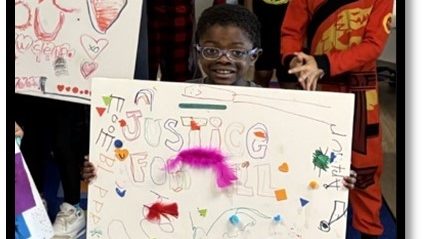
Advocacy Signs
Students studied advocacy and protest signs, identified issues they cared about, and created their own signs to share messages for change in their school community.

Voting Booths
Students built small voting booths with simple circuits to explore why voting matters and how people make fair choices together.
Funding and Support
The Hands-On Justice Project is sponsored in part by:
- Library of Congress Teaching with Primary Sources Eastern Region Program, coordinated by Waynesburg University
- UNCG Coalition for Global Languages and Cultures
- UNCG Undergraduate Research, Scholarship, and Creativity Office
- UNCG Student Educator Learning Factory (SELF) Design Studio
These collaborations link research, design, and teaching, providing teachers with development and support while reflecting the UNCG School of Education’s commitment to bridging research and classroom practice to advance innovation in education.

Contact

Ryan E. Hughes, Ph.D.
Assistant Professor
Teacher Education and Higher Education
UNC Greensboro