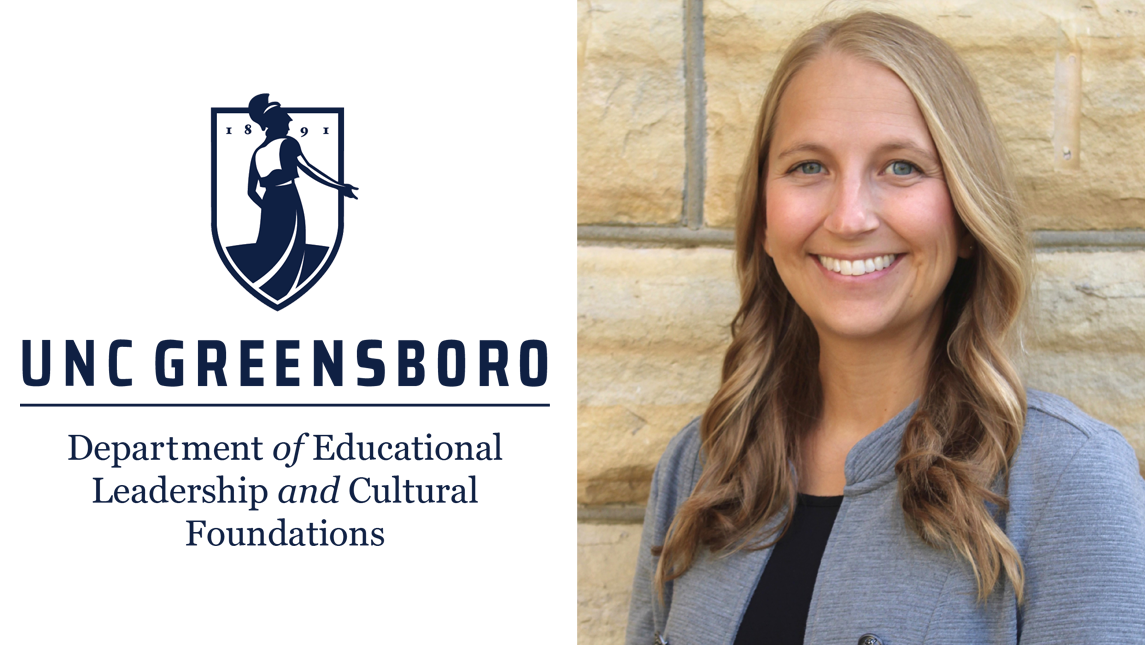
The moment that helped to shape Dr. Lori Kniffin’s career came while she was an undergraduate student at Kansas State University. It happened in Texas while traveling with a group of students on a service-learning trip and visiting with people who were experiencing homelessness.
Now an associate professor at Fort Hays State University in Kansas, Kniffin, who earned a Ph.D. in Educational Studies from UNC Greensboro’s Department of Educational Leadership and Cultural Foundations in 2019, was recently recognized with an Early Career Award from the International Association for Research on Service-Learning and Community Engagement (IARSLCE). Her research centers on service-learning and community engagement – work which can be traced back to that trip to Texas.
“What the award recognizes is that it’s not just your own personal scholarship, but that it’s actually making an impact,” Kniffin said of the award. “For me, it signifies that I was able to have some influence and momentum around that scholarship in a way that shapes the field more broadly.”
Finding a Path to Leadership
Kniffin minored in leadership studies as an undergraduate, believing herself to already be a leader. Through those courses, her view on leadership evolved. “Leadership isn’t a position,” she said. “It’s not something that you are. It’s something you do.”
That message became clearer during a co-curricular program called Alternative Breaks, when Kniffin traveled to Texas to work alongside community partners addressing homelessness. During that trip, the students were able to serve in various roles at a daytime shelter, but also learned about the whole system – things like the need for social workers and the barriers that not having a mailing address can cause. Kniffin was able to have dinner with people experiencing homelessness, visit a nighttime shelter, and speak with politicians.
“That really shaped the power of service-learning,” Kniffin said, “I walked away from that not just feeling good that I did some service, but with a deep awareness of how huge systems like that have to work together. It also shaped my view of leadership, which is that leadership is systemic. You have to lead with the whole system in mind, and multiple people and entities need to be working together.”
Her Path to UNCG
Kniffin found UNCG through a connection to Patti Clayton, then a senior scholar with UNCG’s Institute for Community and Economic Engagement (ICEE), who introduced her to the program and to then-doctoral student Kathleen Edwards. Kniffin worked as a graduate assistant and later full-time at ICEE for three years while completing her degree in December 2019.
Knowing that she wanted to pursue leadership education, Kniffin searched for a program that aligned with her philosophy, which she describes as community based. “Traditional leadership programs were not speaking to me, so I started looking more into higher ed programs. I looked up the coursework and all the things that I read really spoke to me.”
She credits several UNCG mentors, including Clayton, ICEE director Emily Janke, Edwards, and other department faculty with shaping her approach to curriculum and teaching.
Putting Research Into Practice
At Fort Hays, Kniffin teaches a service-learning course each semester, pairing students with local nonprofit organizations. She wants her partners to be “co-educators” and not just provide students with a project, but to build relationships. This semester, the United Way has allowed students to participate in chamber meetings and a homecoming parade alongside their assigned project.
Her research and teaching converge most directly in the Transformational Relationship Evaluation Scale and Reflection Framework (TRES), which is a tool Kniffin developed with a team of collaborators to give members of a partnership a structured way to reflect together on their shared values, goals and dynamics.
The TRES Reflection Framework has been used by practitioners and scholars around the world. Examples include national grant work in Chile to evaluate community engagement across higher education institutions and integration in Amsterdam as part of a learning lab on participatory action research.
What Comes Next
Kniffin splits her time between roles as a faculty member and community engagement administrator and is turning her attention to projects that explicitly bridge her two areas of focus – service-learning and leadership development, including recent work on a community-based storytelling project focused on relationship-based violence. She wants to look at how communities can build the capacity to allow more people to lead on complex issues.
Often, organizations send people for outside leadership development training. Kniffin would like to find a way to keep those people within the group and find ways to do provide that training within and improve the system’s capacity at the same time.
Her advice for UNCG students and alumni hoping to connect scholarship with community work is to stay open-minded about who creates knowledge and where it should be housed. “Community members, students themselves, as well as formal researchers” all generate valuable knowledge, she said. “That knowledge doesn’t always have to go in traditional platforms like published articles.”